
At a glance: productize the delivery, price the client
Productizing a service usually means one fixed price that anyone pays, no conversation needed.
This article argues for doing only part of that.
You can standardise how you deliver while still setting each fee around the client's own situation.
The risk was never the method itself; it's charging one price for work that's worth a different amount to every client, and selling a do-it-yourself version that replaces the conversation where the value actually happens.
The article walks through how to give your work a repeatable shape, keep your judgment as the part a product can't replace, and set each fee around what's at stake in that business.
Productize the delivery. Price the client.
You sit across from two very different clients and quote each of them the same shelf price. One has a contained problem with little at risk, so the fee feels excessive. The other faces a costly decision with several people involved, so the same fee leaves money on the table.
Blair Enns helps explain why the advice on productisation is such a mess.
- In January 2018, Pricing Creativity said to "resist the urge to productize".
- In December 2024, The Four Conversations said productisation was fine as long as you understood the trade-offs.
- By May 2025, AI pressure had shifted the advice to "you should probably productize".
- Then, in April 2026, Enns described "product-enabled consulting" and said the money was in the consulting.
Here is the useful rule: Productize the delivery. Price the client.
In plain terms, give the work a standard, repeatable shape, then set the fee around what is at stake in the client's business.
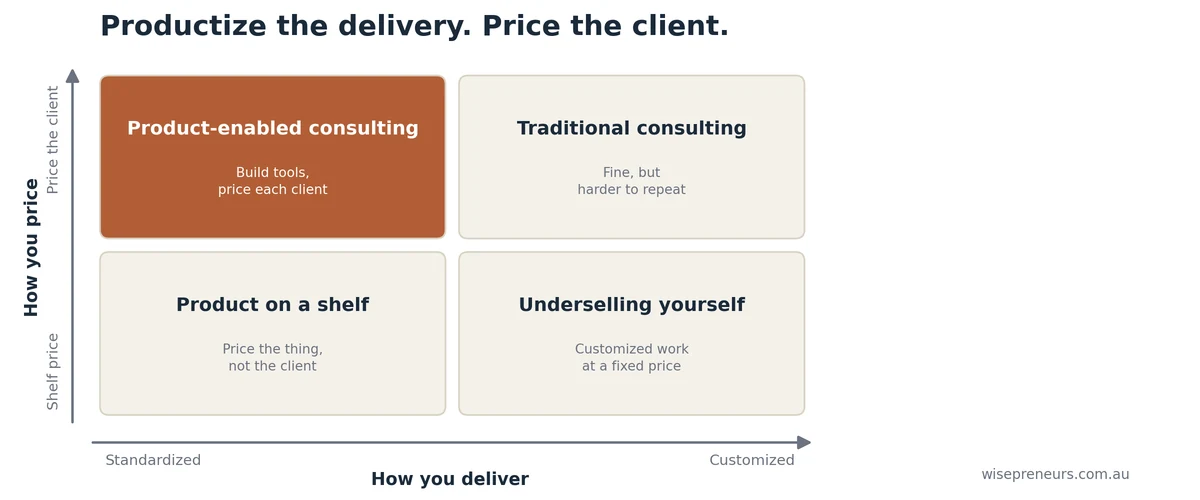
The four ways to combine delivery and pricing. Adapted from Blair Enns's two-by-two in The Four Conversations.
A product can help you do better consulting. Problems begin when you put it on a shelf, attach one price and assume every client should buy the same thing.
A standard service can still have a customised fee
I separate three decisions that often get bundled together under the word productisation:
1. How I do the work.
2. How I describe the offer.
3. How I set the fee.
I can standardise the first meeting, the sequence of questions, the way I assess information and the form in which I present recommendations. I can name the service and explain its boundaries clearly.
The fee can still change according to the client.
Take a consultant who helps family businesses prepare for succession. The same broad process may apply each time:
- establish the ownership picture,
- identify the people involved,
- find the points of disagreement and
- set out a path forward.
The commercial stakes can vary enormously.
One business may have two family members, a modest operation and broad agreement about the future. Another may have several shareholders, valuable property, unresolved conflict and a founder who refuses to let go.
A single shelf price treats those situations as though they carry the same risk and require the same care.
They don't.
The consultant earns the fee by knowing, for example, that if the founder speaks first, the brother-in-law holding 40 per cent of the equity will close down for the rest of the meeting. The consultant also has to recognise when a legal, financial or family matter has moved outside the agreed role.
You can't measure that contribution by counting meetings or pages.
Most consultants can standardise parts of their work, including assessments, question sequences and decision frameworks. A complete shelf offer works best when the scope is contained and the value doesn't vary greatly from one client to another.
A defined piece of work is not worth the same to every business
Many independent professionals productize because they're tired of vague proposals, expanding scope and prospects asking, "What exactly do I get?"
A defined service helps. It gives the client a clear starting point and helps you control the work. Both of you can see where the engagement begins and ends.
Clarity about the work doesn't make its value equal for every client.
A two-hour working session may help one client avoid a minor delay. The same two hours may help another avoid hiring the wrong person, entering the wrong market or spending the next year solving the wrong problem.
The time stayed constant. The value changed.
I would set the fee by asking:
- What decision is the client facing?
- What happens if they delay?
- What could a wrong decision cost?
- How many people will be affected?
- How much access will the client require?
- How involved will I be after making the recommendation?
- How much responsibility am I accepting?
These questions connect the fee to the client's business rather than to a tally of tasks.
A fixed price works well for a contained first step when the commitment, time and likely value are reasonably consistent. It becomes dangerous when the consequences, access requirements and commercial value vary sharply between clients.
Putting a fixed shelf price on a complex diagnostic caps the upside on high-stakes cases while leaving you with 100 per cent of the downside if the work takes longer, exposes conflict or carries more responsibility than expected.
Forcing a product price onto an ongoing relationship creates a different problem. You absorb uncompensated scope risk as new people, information and decisions enter the work.
You can still keep the way you do the work disciplined and repeatable. The fee needs room to reflect the actual situation.
Tools earn their keep inside consulting
Enns gives this model a useful name:
I think of it as product-enabled consulting… the money is in the consulting.
I can build tools while serving clients.
Those tools might include an assessment method, a set of questions, a scoring system, a planning structure, a calculator or a decision framework. Each one captures part of how I approach a recurring problem.
I then use the tool inside the client's business. It may help people make a decision, hold a useful conversation, establish a shared language or continue an agreed practice after I leave the room.
The consulting relationship supplies the context.
A score by itself rarely tells a client what to do next. A template can't decide which issue deserves attention first. A dashboard may show a 15 per cent drop in Q3 leads, but it can't tell you that the head of business development was on long service leave.
Someone still has to interpret what appears, connect it to the client's situation and recommend a course of action.
The client doesn't want to buy a product. They want somebody who knows what they're doing to come in and tell them what they need to do in their own business.
For an independent professional, the product becomes evidence. It shows that you've handled the problem often enough to give your approach a clear form. It makes your method visible and gives a prospect something concrete to examine before engaging you.
It also helps you work consistently because you don't begin with a blank page every time.
I would keep building these tools during real engagements. Improve them when a question fails, a step causes confusion or a client presents a situation you hadn't considered.
Use them where they help the client act, while keeping interpretation and implementation at the centre of the commercial relationship.
Build products while you serve clients
The safest products usually emerge from paid work.
You see the same confusion across several engagements. A useful sequence of questions begins to form. Certain answers start to predict later problems. Over time, those observations become a method.
That approach is very different from disappearing for six months to build a course, toolkit or platform and then searching for buyers.
Client work supplies the raw material. It shows you the language people use, the decisions they struggle with and the points where they stop acting. It also exposes the limits of your method.
A product built this way has a job to do. It supports work that clients already buy.
The result may eventually become a free assessment or a low-priced entry offer. That can help someone recognise a problem and decide whether to take the next step.
The greater commercial value remains attached to interpretation and implementation.
A report may identify a weak market position. It can't hear that when a prospect asks what you do, you list six services because you're afraid of turning away work. A consultant has to notice that behaviour and work out whether the underlying problem sits in the market chosen, the promise made, the proof offered or the way the service is sold.
A framework can organise information. Someone still has to say, "This is the issue to address first, and this is what I would leave alone."
That ability tends to improve after seeing many decisions play out.
when you're a little bit older, you have an advantage
The advantage comes from recognising patterns earlier, remembering what happened when another business ignored a similar warning and asking the missing question. In a succession engagement, that might mean asking, "Who holds voting control if the founder steps down tomorrow?" before the papers are signed.
Age alone doesn't create that capacity. Repeated exposure, reflection and correction do.
You don't have to compress everything you know into a cheap digital item. You can give part of your work a standard form and use it to make your consulting clearer, more consistent and easier to buy.
My own offers: a test, not a template
I have spent more than 20 years running 13th Beach Marketing Services. I have also hosted more than 100 conversations on the Wisepreneurs podcast.
The table below shows the four ways you can work with me. It is a simple illustration, not a model you need to copy.
Offer | Price | Role |
|---|---|---|
Five-Line Assessment | Free | Free first step |
Strategy Intensive | AUD 1,500, 90 minutes | Standard session, published price |
Positioning and Practice Audit | AUD 3,900 | Repeatable audit, published price |
Marketing Partnership | AUD 8,500 foundation + AUD 4,950 per month | Ongoing work shaped around the client |
I put prices on the contained offers so I don't have to price an ongoing relationship as though it were a product.
The Intensive and the Audit have published prices because their boundaries are clear. They let a prospective client experience how I approach a problem without requiring an open-ended commitment.
The Partnership stays inside the client's business. I have to weigh what matters, decide what needs attention, work out what can wait and respond as new information appears. Its price reflects that involvement.
When I consider whether an offer belongs on the shelf, I look at the variation between clients. If two clients could receive very different value, if a wrong decision could be costly, or if I will need access to several people and ongoing information, a single published price may distort the engagement.
I also ask whether the client needs a contained tool or needs me to interpret what the tool reveals. That distinction usually tells me whether a shelf price will help someone cross the threshold or cap the most valuable work.
Productization begins with positioning
The pricing question gets attention because it feels concrete. You can name a service, set a number and build a page.
Positioning requires harder choices.
David C. Baker, co-host of 2Bobs, points to the other half of the argument: productization depends on deciding who you are for, which problem you want to be known for solving and why a client should choose you for that problem.
Without those choices, packaging creates a neat container around a broad service.
A consultant who serves any organisation, tackles any management problem and changes the method for every enquiry has little repeated material from which to build a useful product.
A consultant who works on one costly problem for a recognisable type of client has better raw material.
Repetition reveals patterns. Patterns become questions, checks and decision rules. Those elements can then give a service a consistent form.
Productization therefore exposes your positioning. When I can't explain what repeats, I have to consider whether the market is too broad, whether I'm accepting too many unrelated problems, or whether the chosen problem matters enough for a client to recognise it without a long explanation.
It doesn't replace positioning. You first need a recognisable client, a repeated problem and a clear reason that person would seek your help. The product then gives your method a consistent form.
The AI rush offers an easy way to avoid these decisions. A firm can add AI to an existing service, create a tool and announce something new without choosing a narrower client or problem.
I would start with the client's issue.
AI can help organise information, draft material or speed up parts of production. The client still wants someone who can identify the real problem and say what should happen next.
The timing carries its own warning:
everybody's creating products exactly at a time when your clients want customised help.
That creates an opportunity for an experienced independent professional.
Make the way you work more consistent. Turn repeated thinking into useful tools. Publish a price when a fixed number helps a prospect take a contained first step.
For work that requires you to listen, interpret competing information, identify the decision that matters and stand behind a recommendation, set the fee around what is at stake in the client's business.
Frequently asked questions
How do I decide between a fixed price and a client-specific fee?
A fixed price suits a contained first step with consistent value. Set a client-specific fee when the consequences, access and commercial stakes change sharply from one engagement to another. The test is whether two clients could receive very different value from the same work.
Does productizing my method make me look less premium?
Not when the product is installed inside a consulting relationship rather than sold on a shelf. A repeatable method is evidence that you have done the work often enough to give it a clear form. The judgment that interprets what the tool reveals stays yours, and that is where the fee lives.
References
Blair Enns and David C. Baker, "Productization (Again)", 2Bobs podcast, April 2026. The source of the four-position productization timeline and the quoted lines.
Blair Enns, Pricing Creativity (2018) and The Four Conversations (2024). The first two positions in the timeline.
Related reading inside Wisepreneurs
Sustainable Business Foundations
The Price You Set on Day One Decides Which Doors Stay Open
Every Tuesday I send The Wisepreneur, a short letter for experienced professionals building independent practice: one usable idea a week. Sign up at wisepreneurs.com.au/newsletter
When you want a second pair of eyes on your own practice, the Positioning and Practice Audit is how I work with people: wisepreneurs.com.au/marketing-partnership