
At a glance: Automating the junior work makes the senior work scarcer, and no policy can fix it
A new economics paper shows that automating entry-level jobs can shrink an economy in the long run, even when markets work perfectly and everyone behaves sensibly.
Junior jobs are how people become senior, so removing them backloads pay into later life and fewer people climb the ladder.
Because the outcome is efficient, no policy can reverse it without hurting someone.
For an experienced professional, that means what you know is becoming structurally scarcer, and that scarcity is what you're now paid for.
You are paid for holding something scarce, the way a good location is paid for being scarce.
Here is what economists call an equilibrium rent: a premium you keep earning because what you hold has become scarce, even in a market that works perfectly.
A paper published in August, "Immiserizing Automation" by Vladimir Asriyan, Hugo Reichardt, and Sandro Shelegia, is the clearest proof yet that yours is real and growing.
It shows that automating the entry-level jobs can shrink an economy in the long run, even when markets are frictionless and everyone behaves sensibly.
The reason is straightforward. Junior jobs are how people become senior. You take the low-paid work early, and in return you learn the thing that lets you do the better-paid work later. Automate the junior work and you don't just remove a job. You remove the rung on the ladder.
I've watched this from the other side for years. I hire freelancers on Upwork, and I'm careful about who I choose. I won't hire anyone who's going to lean on AI to do their work, because I need people who can think for themselves.
When you're the one doing the hiring, you can feel the junior pipeline thinning in real time. The people who would have done the grunt work and learned from it are fewer, and the ones left are often the ones who skipped that step.
How automating the junior work makes the senior work scarcer
The economists show what happens next. Automating the junior work doesn't just save a bit of money. It shifts when a career pays out, raising what senior people earn by about as much as it lowers what juniors earn. Over a lifetime the money is about the same. It just arrives later.
That timing is the whole story. People prefer money now to money later. When a career only pays later in life, it looks less attractive, so fewer people climb the ladder. The supply of experienced people slowly dries up. The economy shrinks, because the path that used to make experts stopped being worth taking.
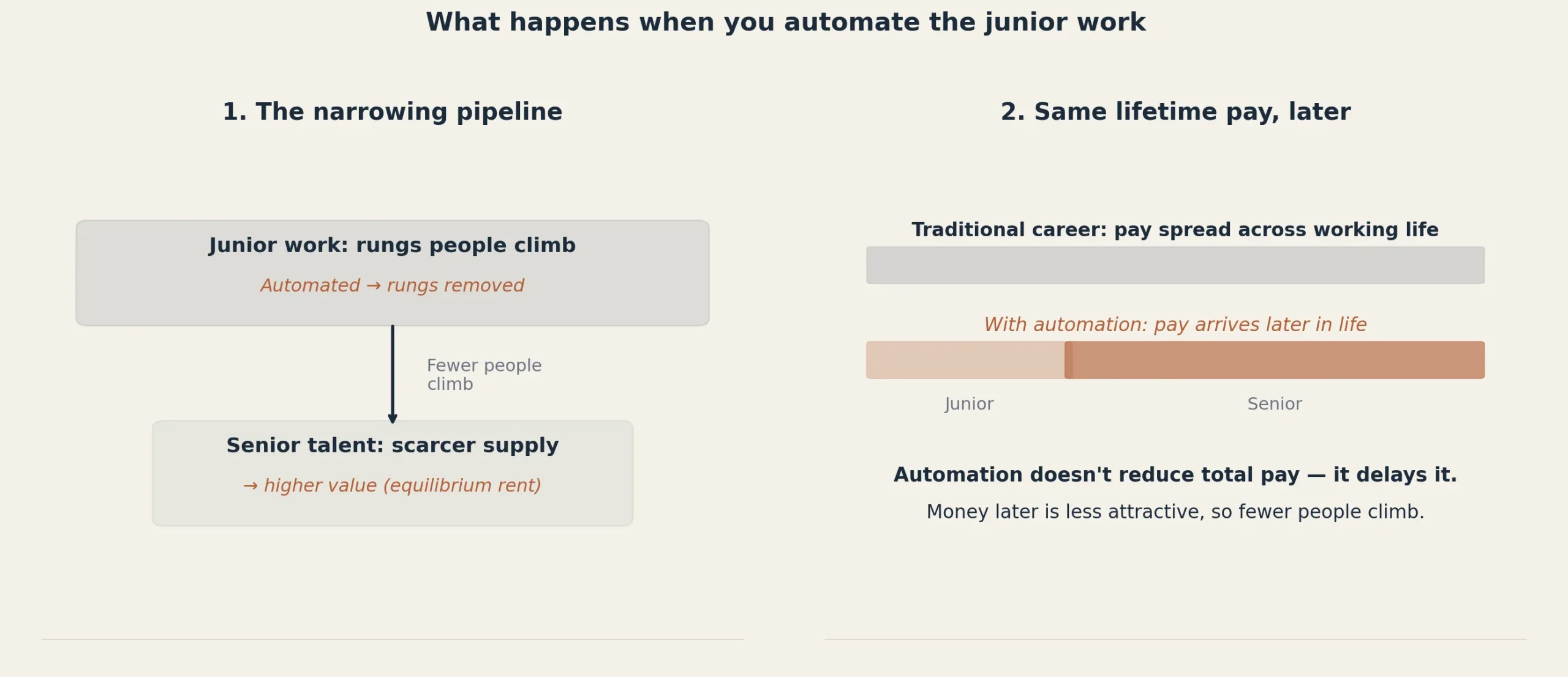
The market can work perfectly and still make what you know scarcer, year by year. There is no failure to fix and no one to blame.
What that does to what you're paid
When someone pays you for a deliverable you produce now, or a decision you make this week, you're being paid for effort applied now. That's a wage.
As AI does more of the producing, the bottleneck shifts to judging which options matter, which is exactly the thing your experience is built to do.
As the pipeline narrows, something gets added to the price. You hold pattern recognition that only comes from having done the junior work years ago and watched how the decisions played out.
You're paid for holding something scarce, the way a good location is paid for being scarce. That's the equilibrium rent I opened with, and it survives even in a perfectly working market because nobody can quickly make more of what you hold.
Wage | Equilibrium rent |
|---|---|
Paid for the effort you apply now | Paid for holding something scarce |
Goes up and down with this week's work | Survives even in a perfect market |
Anyone can supply it faster | Nobody can quickly make more of it |
This paper is the cleanest argument yet that the rent on experience is real and growing. The premium comes from holding something scarce. Nothing about working harder or faster generates it, because the thing you hold cannot be produced quickly at all. And because the paper shows the pipeline narrowing in a market with nothing to fix, that rent is only going to climb.
Why this paper matters more than the earlier ones
The other research that reached this conclusion needed something to go wrong. A market friction. A broken contract. Something a policymaker could, in principle, fix.
This paper needs none of that, and that's what makes it hard to dismiss. It takes a market with no frictions and fully efficient outcomes, and the economy still shrinks. The premium on what you hold rises with the narrowing pipeline, each year, with no one to blame.
Term | What it means |
|---|---|
Equilibrium rent | a premium you keep earning because what you hold has become scarce, even in a market that works perfectly. |
Immiserizing automation | automation that removes the junior rungs people climb to become senior, shrinking the economy in the long run. |
This cuts both ways
The same mechanism that makes what you know worth more is the one that ends up starving the next generation. The senior people win now. The junior people lose, because the rungs they need are being hollowed out and pulled up. If you're an experienced professional, right now you're on the winning side of that trade.
That makes mentorship more than a nice thing to do. You can hold two true things at once: the thing you know is worth more because the pipeline is narrowing, and you have a reason to keep that pipeline open anyway.
Not out of charity. Because a world where nobody can learn what you know is a world where the thing you sell stops being understood. The paradox of expertise is that the more you've built, the more it depends on other people still being able to learn it.
What you do with a scarcity nobody can fix
Stop competing on speed. The contest the AI vendors want you to join in on is who can produce the most output per hour. That's a wage contest, and it's one you lose. I've covered how experienced professionals avoid the AI commoditisation trap, and the way out is always the same: hold something that can't be produced quickly at all.
Name what you actually know in concrete terms. The rent is only visible to a buyer if you can point to it. Thirty years of experience is an archive, and nobody pays for an archive. Being able to tell within one conversation whether a client's pricing is the problem or their message is, is a capability, and that's what rents are made of. It's the same reason experience commands premium rates when knowledge alone doesn't.
Keep the pipeline open on purpose. Teach someone. Take on work that keeps you doing the junior-level thinking yourself rather than supervising it. The rent on your experience only keeps compounding while you keep doing the work that built it.
The economy is not going to fix this for you. That's the point of the paper. The market can be working perfectly and still make what you know scarcer, year by year. Nobody is coming to reopen the pipeline.
So the work is yours: name what you hold, keep doing the work that built it, and keep a door open for the people coming up behind you.
Frequently asked questions
Is this just a theory?
It's a working paper, so it hasn't been through full peer review yet. But the authors also test the idea against US data since 1980 and find the pattern they predict: industries where automation hit junior work hardest saw bigger job losses, an older workforce, and a steeper gap between what young and old workers earn.
If the market is working perfectly, how can the outcome be bad?
Because efficient and good are not the same thing. The outcome is efficient in the sense that you can't make anyone better off without making someone else worse off. But the people who win are the current generation of experienced workers, and the people who lose are the next one. Efficiency is not the same as a fair future.
Does this mean AI is bad for experienced professionals?
Narrowly, the opposite. The paper suggests the experienced are the winners, because their scarcity rises and so does their price. But it's a qualified win, because the same force that raises your price also starves the people who might one day buy what you do.
How do I make the scarcity work for me?
Stop competing on speed and start positioning the thing that cannot be produced quickly. Describe what you actually do in concrete terms rather than as years of experience. And keep doing at least some of the junior-level thinking yourself, so the pattern recognition your value rests on stays sharp.
References
Leanne Shelton AI for Independent Professionals: Keeping the Human Edge.
Wisepreneurs Project podcast, Episode 59, on keeping the human edge as AI takes over the routine parts of professional work.
Jon Younger Professional Relevance: Positioning Expertise When AI Does the Routine Work.
Wisepreneurs Project podcast, Episode 79, on positioning expertise when AI handles the routine work and staying relevant as an experienced professional.
Asriyan, V., Reichardt, H., and Shelegia, S. (2026). Immiserizing Automation. Working paper, CEPR DP21872, August 2026. The primary source for this article. It shows that automating entry-level jobs can shrink an economy in the long run even when markets work perfectly, which is the mechanism behind the rising value of what experienced professionals hold.
Every Tuesday I send The Wisepreneur, a short letter for experienced professionals building independent practice: one usable idea a week. Sign up at wisepreneurs.com.au/newsletter
When you want a second pair of eyes on your own practice, the Positioning and Practice Audit is how I work with people: wisepreneurs.com.au/marketing-partnership