
Burnout comes from how the work is arranged
Burnout usually starts with a sensible professional. The work has to pay, so you say yes to everything, do everything yourself, and underprice the hours so there are always more of them coming.
The fix has little to do with willpower.
You reduce the load by doing less and handing the rest to tools and systems, you price the work you keep so it is worth the hours it costs you, and you plan around your energy instead of hoping for the best.
The way you arrange the work decides whether you burn out.
The client work has to keep coming in. When you start out, you didn't quit and give away your salary with a year of runway to try things and see what works. So you say yes when work turns up, then take on the bookkeeping and the technology the old job used to provide, and think to yourself that you're going to be able to take some time out and rest when things settle down.
Things don't settle down. They stack up, and one day the practice you built is running you, and you end up being too tired to see where it went wrong.
How you arrange the work decides whether you burn out. Do everything at once, underprice the hours, and rest only when there is time left over, and the practice will run you down no matter how disciplined you are. Arrange it differently, and you can keep going for a long time. That is what this article is about: the arrangement.
The trap is doing everything, everywhere, all at once
Mark Elliott names the trap when I interviewed him for the podcast. He works with professionals who have left a career to run their own business, and he described what happens when someone tries to cover every channel at once.
They do everything, everywhere, all at once. And because they're doing so much, they find that they're not as successful ultimately as they would hope to be.
Mark Elliott
Exhaustion is not the only cost. When you are spread across social media, public speaking, client delivery and marketing, none of it is quite good, and you cannot see which part of it is actually working. You mistake activity for progress, so you keep doing more of everything, which is the same decision that wore you out in the first place.
The way out starts small. List everything the practice asks of you, and pick the two or three things that actually bring in the work and serve the clients well. Do those properly. Let the rest go for a while, and watch whether anyone notices. Mostly they won't.
The hidden driver is often the price
Here's the bit most burnout advice skips. The hours are often a symptom, because you are not charging enough for the work on the other side of them.
Robert Vlach has spent years helping independent professionals set their rates, and he described what he sees when he is the one buying. He can tell when the person on the other end of the arrangement is working sixteen-hour days for too little money.
I don't want you to burn out in a half a year or so. I'm the first one willing to pay you extra if you decide to ask for it.
Robert Vlach
The client can see what is coming before you can. When you undercharge, you need more clients and more hours to cover the month, so the calendar fills with low-value work and the energy drains in the wrong direction. The fix for exhaustion is sometimes not a holiday. It is a higher rate, so the work you keep is worth the hours it costs and you can afford to turn the rest down.
Anna Molnár makes the same point from the other side. She coaches women building their own businesses, and she told me they often start from passion and then forget the part that keeps the whole thing alive:
But then they kind of forget that there is also the money making aspect of it.
Anna Molnár
A practice you love can still burn you out. Being profitable is not being greedy; it is the thing that buys you room to breathe. If the work has to keep paying, and it barely does, the only honest move is to raise the price. I have written separately about how that happens in the capacity problem, but the link to burnout is the same: a crowded calendar at a low rate is a slow way to stop.
You cannot out-work a depleted system
Once the structure is closer to right, energy becomes something you can manage instead of something you keep losing.
Charlotta Segerlund-Darnell trains people in psychological strength, and when I asked her where she starts with someone who is stressed, her first questions were not about the work at all:
How do you sleep, how are your days? What stress management do you use already?
Charlotta Segerlund-Darnell
She asks because it tells her how close someone is to burnout, and how much they can take on. If you are not sleeping and the days have no shape, the answer is not more advice or harder effort. It is to calm the system down first. That is a different thing from pushing through, and it is the part high-achieving professionals are worst at accepting.
Lisa Ross-Marcus made the same point from her own experience. She launched her business as a first-time mother, on top of other work, and she overloaded herself without realising how far she had gone.
You've also got to really understand what is sustainable for you, because you don't want to burn yourself out. Because you're no good for yourself. You're no good for your family, your friends, and you're no good for your clients.
Lisa Ross-Marcus
She was also clear about what it costs to learn this late. Turning down one opportunity can feel like the last one you will ever get. It rarely is. Pacing yourself is not a luxury you earn after the business is secure; it is one of the things that keeps the business secure.
If you want to go deeper on this side of the work, Relational Vitality is the part of the Insight Hub built around health, recovery and cognitive longevity.
Off-load the load you are carrying alone
A lot of the exhaustion in a one-person practice is not the client work. It is the remembering: the tasks you hold in your head, the emails you write twice, the setup you repeat every time a new client arrives.
Your mind is for doing the work and making the calls, not for holding all the details. Hand the details to something else.
Start with the smallest off-load. If you write the same reply to new enquiries, save it as a template. If you type the same address and links over and over, put them in a text expander and type a short code instead. Neither costs anything, and each one stops a small piece of your attention leaking away every week.
The next level is a single place that exposes the work, so you are not carrying the to-do list in your head. A simple board with a few columns is enough for most practices. Then look for the one repetitive task that eats the most time, and automate just that one. It is usually the same shape every time: a new client, a new folder, a new set of accounts. A short automation can turn those steps into one action, and the energy you get back is real.
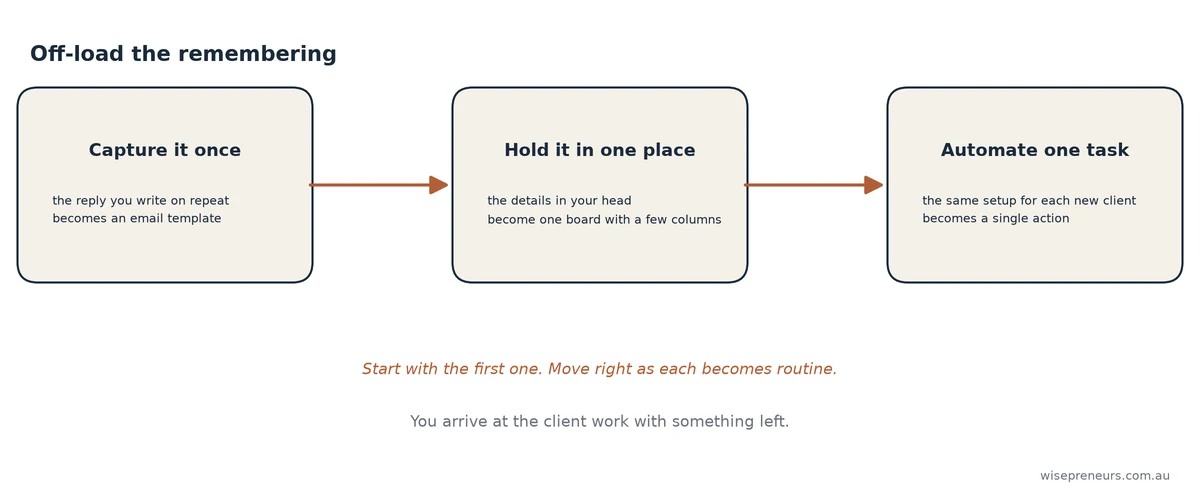
The off-load ladder: move the repetitive work out of your head one step at a time, and you arrive at the client work with something left.
A practice that fits
None of this is about working harder, and it is not about doing everything and just squeezing in a walk at the end. It is about building a practice that is the right size, at the right price, with the energy looked after deliberately.
Do less, so the work you keep is good and you can see where the success is coming from. Charge enough that the work is worth the hours. Protect your sleep and recovery before the stress arrives, not after. And hand the remembering to tools, so your head is free for the work only you can do.
That's what a sustainable practice looks like. It's also, in a roundabout way, what keeps the work enjoyable. You built the thing to live on your own terms, and it only does that when it is arranged not to wear you out.
Next steps
Start with the audit Charlotta starts with. Ask yourself how you are sleeping, what shape your days have, and what you already do to manage stress. That tells you how much room you have to move.
Then pick one lever and pull it this week. Turn down the next thing that does not fit. Raise one rate. Automate one repetitive task. Any one of them is the beginning of an arrangement that holds.
To see where your focus and recovery are actually going, start with the Cognitive Capital Optimiser, a short free assessment.
Frequently asked questions
What are the early signs of burnout for an independent professional?
The first signs show up outside the work: poor sleep, days with no clear shape, low energy, and reaching for distraction instead of rest. Charlotta Segerlund-Darnell starts her work with exactly those questions, because how you are sleeping is a better early warning than how hard you are working.
Is working less the answer, or do I need to charge more?
Often both, and they pull in the same direction. When you undercharge you need more hours to cover the month, so the calendar fills with low-value work. Raise the price, and you can afford to work less and turn down the work that drains you.
What systems reduce burnout in a one-person business?
The ones that get the remembering out of your head: email templates, a text expander, one simple board to hold the work, and a single automation for the repetitive task you repeat with every new client. Each one returns a little energy every week.
References
Wisepreneurs Podcast, episode 17 — the everything, everywhere, all at once trap
Wisepreneurs Podcast, episode 38 — what a client sees when you undercharge
Wisepreneurs Podcast, episode 42 — the money-making aspect
Wisepreneurs Podcast, episode 33 — how close are you to burnout
Wisepreneurs Podcast, episode 15 — what is sustainable for you
Every Tuesday I send The Wisepreneur, a short letter for experienced professionals building independent practice: one usable idea a week. Sign up at wisepreneurs.com.au/newsletter
When you want a second pair of eyes on your own practice, the Positioning and Practice Audit is how I work with people.