
A note-taking system is the scaffolding you lost when you went independent.
The point isn't just storing what you read, it's using it again. An AI that reads the same notes you do changes which one you get, but it only helps if you stay in the loop.
Here's how my own second brain runs, what four podcast guests taught me about building one, and what the machine still can't do for me.
The notes are still mine, in my words. What changed is that I can reach them the moment I need them, and a machine helps me see the connections I'd have missed on my own.
You might have arrived looking for a second brain for consultants. That's who I mean when I say independent professional, so from here I'll use that broader word, which covers the consultants, coaches, authors and experts I work with.
For about two years I've kept my notes in Obsidian, an app that holds them all as plain text files. Readwise, which pulls in the highlights from every article and book I read, has been feeding it for longer.
Between the two I built something that sits between my brain and the page. People call it a second brain. I call it a place where something I read six months ago can surface again on the day I'm working on a problem that needs it.
What I didn't notice until recently is that the thing has changed. It used to be storage because I put things in there so I could find them later. Now an AI reads and writes the same notes I do. It searches them, connects them, and drafts from them. The second brain has gone from a filing cabinet to something I work alongside.
What I was actually building
None of this started as a productivity project. It started the way it starts for a lot of people who leave an organisation: you lose the scaffolding you didn't know was supporting you. The shared documents, the CRM, the colleague who catches what you miss, the meeting rhythm that makes some decisions for you. Then it's just you and a laptop.
I had to rebuild all of that alone, and the notes are where most of it ended up living. That's what a second brain is. It's the organisation, stored and carried around in your files.
The mind has limits, and having the right outside structure extends them. Four podcast guests showed me four different things to build around those limits.
What four guests taught me
Sönke Ahrens, who wrote How to Take Smart Notes, spoke about the way the technology drops away once the structure is right.
I feel way more immersed in my own thoughts,” he said on episode 73. “I can see multiple notes that belong together.
He keeps only the last thirty days of unprocessed highlights in view so it never overwhelms, and he describes what matters: treat your reading “less like a bucket you need to empty, and more like a river you can pick stuff from.” Storage, or flow. That distinction rearranged how I keep notes.
I've written the method out in full before, under the heading of smart notes.
Eliška Šestáková came to note-taking through her PhD. Writing her computer science dissertation, she was buried under articles, books, and her own half-finished thoughts. She found the book by Googling and, as she put it, “I wasn't giving it high hopes.”
What she learned is the part most tools skip: capture isn't the point. Highlights in an e-book gave her what she called “maybe just the illusion” of doing the work, because “it didn't matter how many highlights I took. I really needed to take my own notes.”
The value is in turning a highlight into your own words. She also kept in mind a way to steady herdrlg when a shiny new app appeared: Niklas Luhmann, the most famous Zettelkasten user, never had a note-taking app. He had a wooden box of cards.
The digital how-to, with both her and Ahrens, is in an earlier piece on knowledge systems.
Tonianne DeMaria made the invisible workload visible. Personal kanban is three columns and a work-in-progress limit, almost too basic, but on episode 63 she explained why it works well when you work alone.
In an organisation your workload is partly managed for you. Alone, nobody sees your doing column except you, and making it visible changes how you say no. Her reason is worth remembering: “completion literally feels good. You get a neural reward from completion.” A board that rewards finishing keeps the pull of novelty at bay.
Hazel Edwards OAM has about 220 published books, more than most independent professionals will write in several lifetimes. On episode 43 she described a rhythm she learned from a lecturer at teachers' college: he designed his books in the morning, and in the afternoon he ran a plant nursery. “He had the balance of his hands in the dirt.” Creative work, then physical. The body resets the mind, and it's part of the system as much as the notes are.
Different tools, the same instinct. Ahrens on the flow of notes, Šestáková on processing, DeMaria on the visible workload, Edwards on the body. Each one rebuilt a piece of the scaffolding an organisation used to provide.
The thing storage can't do
You can store everything and still use almost none of it. Luc P. Beaudoin, a cognitive scientist, has a name for the stuff you keep and never reach for again: the folder of highlighted articles you never open. A note-taking system stores knowledge. It doesn't, by itself, make you use it.
Beaudoin's answer is to decide before you keep. He asks four questions of anything that wants a place in your system:
- is it high-calibre,
- is it useful,
- is it potent, and
- does it appeal to you?
Most of us capture everything and keep all of it, which is how a second brain turns into a warehouse. The discipline is deciding what deserves to live in it, and what you'll actually going to use.
What AI adds, and what it doesn't
Lia DiBello, a cognitive scientist, frames it this way: our species were tool users before we were anything else, and the first tool we ever used to change our own thinking was language.
A second brain is a tool in that same line, and an AI that works inside it is the next one. People who've lasted decades in independent practice have always done this: they take on a new tool the way their forebears did language, and keep it in proportion.
So what does it actually do inside my second brain? Not what I expected. It doesn't make me act on a note I never processed. What it does is find the things I only half remember. Often I'll know I read something a guest said, or a line from a study, but not who said it or when. The model finds it in a minute, the note and the episode and the quote, and I can check whether the connection is real. It's still surprising what surfaces.
Stephen Anderson and Karl Fast, in Figure It Out, name the four moves between raw information and real understanding:
- finding what's worth reading,
- adjusting it to your situation,
- getting it out of your head and onto a page, and
- building the new idea.
That's a realistic map of how to process our work we need to do. The machine (AI) is stronger at the first two, so I give it the hunting and the reformatting and keep the building for myself. That's the clean split. Ethan Mollick calls it working like a centaur, each of you doing the part you're better at.
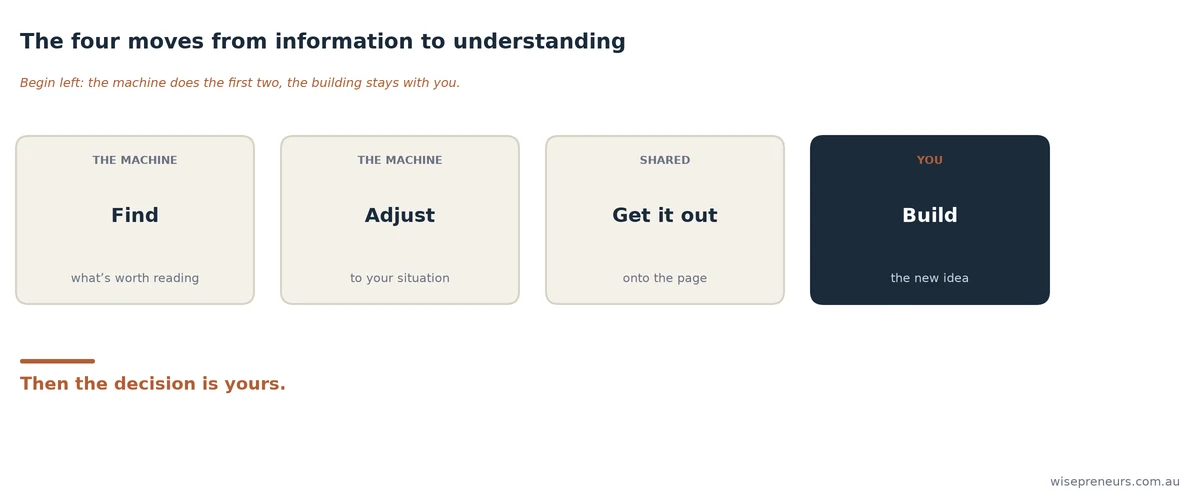
The four moves named by Stephen Anderson and Karl Fast, and where I split the work: the machine takes the hunting and the reformatting, the building stays with me.
Mollick names a second way of working, and that best now describes most of what I actually do. He calls it the cyborg: the human and the machine tangled up in a back-and-forth, drafting and pushing back and redrafting.
He also warns that the edge of what AI can reliably do is jagged. The model can write a professional-sounding paragraph and then confidently invent a rule that doesn't exist, and you can't tell which is which until you look. I spend a lot of time doing just that, editing.
So the back-and-forth has a rule in how I go about my practice: most of the time I catch the errors, but I don't trust my first go. I have a second model check what the first one produced, and I check every quoted line against the source it came from. That's where the invented rule and the misquoted guest or idea show ups, before anything reaches a client.
Where I draw the line
The machine gathers, drafts, and flags. I check every quoted line against its source, and I decide what to act on.
Keeping the deciding for myself is the point of it all; I've said more about working with AI without losing your expertise.
And that all keeps circling back to the notes. DiBello's line is that people reshuffle what they already have more than they add something new. The point of a second brain was never to store more. It was to make what I already have ready to be reshuffled on the day I need it, and now a machine does part of that with me.
The notes are still mine, in my words. What changed is that I can reach them the moment I need them, and a machine helps me see the connections I'd have missed on my own.
This sits inside the wider Relational Cognition writing on independent practice.
Frequently asked questions
Is AI a replacement for note-taking?
No. AI changes what the system does with your notes, it doesn't remove the need to take them. Your notes are the raw material, and an AI that reads them helps you search, connect, and draft from what you already have. The capture and the processing still have to come from you, because the value is in your own words and your own experience.
Which note-taking approach works best for experienced professionals?
The method matters less than the habit of processing. A Zettelkasten, the method Sönke Ahrens popularised, works well because it forces you to put ideas into your own words and connect them, but the same result comes from any simple system you actually maintain. The common failure is capturing everything and processing nothing.
What should I use AI for when I work with my notes?
Use it for the work it's good at and hold back the rest. AI is strong at finding what's worth reading and adjusting it to your situation, and weak at building the genuinely new idea. Let it gather, draft, and flag. Keep the decision about what to act on for yourself, because you can see the context it can't.
How does a note-taking system support a sustainable practice?
It turns your reading and experience into material you can reach for instead of lose. When a client problem or a new article needs your past thinking, the notes surface it. That retrievability is the difference between knowledge that sits inert and knowledge you actually use, which is the difference between staying sharp and slowly going stale.
References
Sönke Ahrens on turning professional experience into lasting insight with smart notes.
Wisepreneurs Podcast, episode 73, on the Zettelkasten and treating notes as a river rather than a bucket.
Eliška Šestáková on building smarter knowledge systems.
Wisepreneurs Podcast, episode 60, on why capture is not the point and why a wooden box was enough for Luhmann.
Tonianne DeMaria on personal kanban and visual workflow.
Wisepreneurs Podcast, episode 63, on making the invisible workload visible.
Hazel Edwards OAM on writing practice and longevity.
Wisepreneurs Podcast, episode 43, on the rhythm of creative work and physical work.
Sönke Ahrens, How to Take Smart Notes: One Simple Technique to Boost Writing, Learning and Thinking.
Stephen Anderson and Karl Fast, Figure It Out: Getting from Information to Understanding.
Ethan Mollick, Co-Intelligence: Living and Working with AI.
Luc P. Beaudoin, Cognitive Productivity with macOS.
Every Tuesday I send The Wisepreneur, a short letter for experienced professionals building independent practice: one usable idea a week. Sign up at wisepreneurs.com.au/newsletter
When you want a second pair of eyes on your own practice, the Positioning and Practice Audit is how I work with people: wisepreneurs.com.au/marketing-partnership