
What two Wisepreneurs episodes reveal about turning accumulated expertise into structured thinking
Two of our most-downloaded Wisepreneurs episodes share a quiet obsession: how experienced professionals can structure what they already know so it compounds rather than fades.
Eliška Šestáková a note-taking systems researcher at Czech Technical University, and Sönke Ahrens, author of How to Take Smart Notes, approach this question from different directions but arrive at the same conclusion: accumulated expertise only becomes a professional asset when you build a system to work with it.
For experienced independent professionals who struggle to articulate decades of pattern recognition into publishable thought leadership, these two episodes together offer a practical blueprint.
The problem both episodes diagnose
If you have spent twenty or thirty years in a profession, you carry an enormous amount of implicit knowledge. You can diagnose problems others miss. You sense when a project is drifting before the data confirms it.
But when someone asks you to write about what you know, or to position yourself as a thought leader, you face a surprisingly difficult task: your expertise is distributed across thousands of conversations, readings, and decisions that have never been written down in one place.
Eliška calls this the gap between being an archivist and being a writer. Most professionals hoard information, she explains, highlighting passages, saving articles, filling notebooks. But hoarding without processing leaves you with a pile, not a practice. When the communication is one-directional, notes become archives that never pay returns.
Sönke frames the same problem through what he calls the in-between step that most people skip. The gap between reading something interesting and producing a finished article is where most professionals stall, because they have no structured place to do the thinking that connects one idea to another.
Two complementary frameworks for the same challenge
What makes these episodes particularly useful together is that Eliška and Sönke tackle the problem from opposite ends.

Eliška is a systems builder. Her episode walks through the practical architecture: how to choose a note-taking app without falling into the "shiny new app syndrome", how to use bidirectional links to surface unexpected connections, how to set up project pages as "hooks" that collect material over weeks before you write.
She draws on her experience with Roam Research, Obsidian, and Tiago Forte’s Building a Second Brain methodology to explain how information management and knowledge development layer onto each other. Her advice to someone starting from zero is refreshingly practical: try ten apps briefly, choose one, use it for two months, and remember that Niklas Luhmann built one of the most productive academic careers in history using wooden boxes and paper cards.
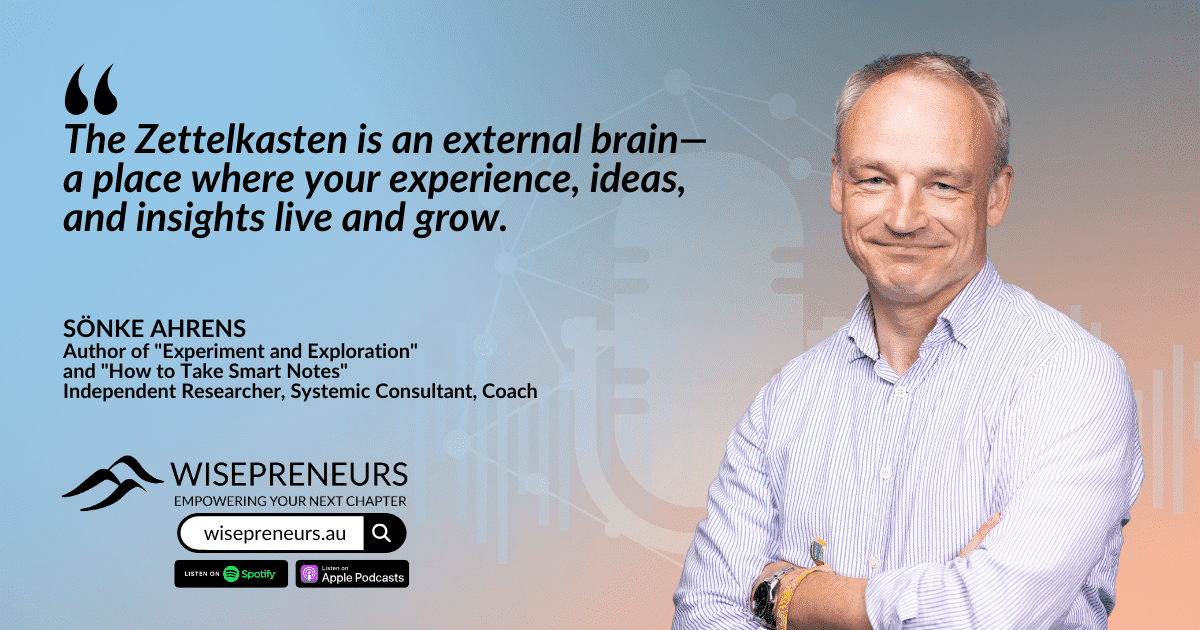
Sönke is a thinking architect. His episode goes deeper into why the Zettelkasten method works as a cognitive tool, not just an organisational one. He explains that the system’s real value is in the bottom-up emergence of structure.
Rather than starting with a plan and filling in research underneath it, you collect ideas as they arrive, let connections form between them, and discover what you actually think through the act of writing notes into your own words.
For experienced professionals, he argues, this approach is especially powerful because they already have the boldness to be selective, to not take on new information at face value but to interrogate it against decades of practice.
Where the two conversations meet
The episodes connect in a way that neither could achieve alone. Eliška gives you the infrastructure. Sönke gives you the thinking methodology to use within that infrastructure. Together they describe a complete knowledge system:
- Capture ideas when they arrive (both emphasise lowering the threshold so fleeting thoughts do not vanish)
- Process them in your own words (Sönke’s deliberate practice of understanding, Eliška’s distinction between archiving and writing)
- Connect them to what you already know (bidirectional links, Zettelkasten note sequences, the act of confronting one idea with another)
- Let structure emerge over time rather than forcing it from the top down (both reject the linear plan-then-write model in favour of a more natural, iterative process)
The two guests even collaborated directly. Sönke mentions that Eliška was instrumental in developing his Zettelkasten with Obsidian course, and Eliška credits Sönke’s book as the catalyst that sent her searching for a digital implementation of the method. Their work is a genuine intellectual conversation, not just two people covering similar ground.
Why this matters for independent professionals over 50
The Wisepreneurs thesis is that accumulated professional wisdom, the pattern recognition developed through decades of practice, represents competitive advantage that appreciates with age and cannot be replicated by AI. But that advantage remains latent until it is articulated.
A knowledge system like the one Eliška and Sönke describe is not about becoming more organised. It is about building what cognitive scientists call an extended mind: an external thinking space that amplifies your internal capability rather than merely storing information.
When you have a functioning Zettelkasten or structured note-taking practice, you are not starting from a blank page every time you need to write an article, prepare a keynote, or articulate your niche. You are drawing from a reservoir of your own processed thinking.
For someone building an authority-based practice, this is the difference between constantly generating content from scratch and having a system that compounds. The more you use it, the richer it becomes.
The connections multiply. And the insights that emerge, the ones that make your perspective distinctive, arrive not from trying harder but from having given your accumulated expertise a structured place to develop.
Where to start
Sönke’s advice for someone beginning from zero is the most practical starting point from either episode: do a brain dump. Write down everything you are currently interested in developing, deepening, or writing about. Do not try to replicate everything in your head. Just capture what is alive for you right now. Sort it into a few areas of interest. Use those as the initial scaffold to hang new ideas onto.
Eliška’s advice complements this: choose one tool, use it for two months, and resist the urge to switch. The tool matters less than the habit. And the habit matters less than the principle, which is to move from passively collecting information to actively doing something with it.
Listen to both episodes together. Eliška’s gives you the practical scaffolding. Sönke’s gives you the intellectual framework that makes the scaffolding worth building.