
At a glance: The most downloaded episode of the Wisepreneurs Podcast is a conversation with Filip Drimalka, who joined me from a workation in Sri Lanka in February 2025.
He made two arguments: that moving somewhere else lets you see your own work from above, and that AI is worth using at every step of a process as long as you're the one orchestrating it.
Eighteen months on, the second argument has been tested by research he didn't have at the time, and the results are disturbing.
Students, developers and specialists who leaned on AI performed better while they had it and worse once it was taken away.
What survives from that conversation is the guardrail rather than the enthusiasm, and it applies to both decisions: any change to how you work either keeps you engaged with the actual material or creates a gap between you and it.
Distance from the work is the cost that never shows up on the invoice.
The most downloaded episode I've recorded is a conversation from February 2025 with Filip Drimalka, who joined me from Sri Lanka. He was a few weeks into a workation with his daughter, on his way to South by Southwest, the tech and music festival in Austin.
Since then the AI tools for independent consultants we discussed have stopped being novel, and the research on what they do to your thinking has caught up. Most of what Filip said has aged well. One part needs a correction, and it's the part that gets quoted.
More people have listened to that hour than to anything else on the podcast, and that tells me the demand was real. The article I wrote from it, at that time, was the part that failed.
A workation changes your working environment, and that's the point
Filip is careful about what he does when he travels, and his approach is different to what most of us have in our heads when we hear the term workation.
I was influenced by Tim Ferriss a lot and I love his podcast and everything. And I think there are two differences. The one is that he's talking about escaping.
And I'm talking about doing better work.
Filip Drimalka, Wisepreneurs Podcast, episode 67
When I asked him what travel actually does for him, he didn't say the beach. He talked about perspective: getting out of the office to get a good look at your own work from above, rather than chasing the busy work and the to-do list from inside it.
Then he said the part that explains why it works at all. It doesn't have to be travel. Go and work from your nearest coworking space.
Sri Lanka and the coworking space down the road have one thing in common: your habits don't already run there.
That's why your working environment is part of how you think rather than a backdrop to it. Your brain builds its expectations from wherever it is, so put it somewhere it can't predict and it starts noticing again.
There's a real cost on the other side, and Filip's own set-up shows it.
He still travels with a Moleskine notebook. He books hotels a day or two ahead using apps he trusts.
He arranges the trip around events where he'll be in a room with people. So the notebook came with him, and the connection, and the rooms full of the right conversations.
What stayed behind was the desk, the door that closes, the second screen and the ritual of shutting the work down when the day ends, and those do real work too.
The honest version is narrower than "work from anywhere". A change of place earns its keep when you rebuild the conditions you actually think in and deliberately load the trip with what a normal week can't give you: unstructured hours, walking, rooms full of people who do something adjacent to what you do.
It costs you when you relocate the laptop and lose the rest. The research on fully remote work says something similar. The productivity numbers are mildly negative on average, and the first things to go missing are mentoring and the accidental teaching that happens when people share an office or work in the same building.
The part of Filip's argument that has aged best
Filip bought the futureofnowork.com , a no longer live domain, on day one of ChatGPT, which tells you how early he was. His central claim was that AI would sit inside most processes without doing any of them end to end.
Sometimes people expect that AI will do the whole work like, okay, so I have this old website and new website do the redirect. Maybe in five years it will be capable of doing that, but still you're the one who is orchestrating that.
Filip Drimalka, Wisepreneurs Podcast, episode 67
I had just told him about migrating a client's site to a new platform and redirecting the old pages so nothing was lost to the search engines. At the time ChatGPT walked me through it. That work would previously have been completed with specialist help, and I'd have had no real idea what was done to the site.
Orchestrating is a bigger word than it looks. It means you decide which parts of the job the machine takes, in what order, and whether what comes back is good enough to build on.
On the redirect job that's easy, and it's worth saying why. Redirect work is basically using a plugin and some patience, and the work tells you when you've got it wrong. Pages resolve or they don't. Crawl the site afterwards and the mistakes are sitting there in a list. Being better at it next year wouldn't do a thing for any client of mine, so handing it over costs me nothing at all.
Most of what gets celebrated about AI is that case, and that case was never at risk. The difficulty starts with the other kind of task, where nothing tells you the output is wrong except you.
What the research since 2025 says about handing over the thinking
Filip also said something in that conversation that I've been thinking about.
I don't have to think. I can outsource part of the thinking to AI.
Filip Drimalka, Wisepreneurs Podcast, episode 67
He meant it precisely, and he qualified it immediately: part of the thinking, for a specific part of the process.
The studies that have been published since make that qualifier the whole ballgame.
A 2025 trial with about a thousand high school maths students found that the group given unrestricted access to a language model did better while they had it and worse than the control group once it was taken away.
A 2026 study of developers learning an unfamiliar software library found the same shape: no productivity gain, lower scores afterwards, and measurably weaker debugging skill.
The finding to consider:
Across the studies since 2025, the people who leaned on AI performed better while they had it and worse than the control group once it was taken away. The gain was real, and it was rented.
The mechanism is well understood in learning research. The difficulty that slows you down while you're working is often the difficulty that was building the capability, so removing it feels like progress while rehearsing nothing.
Then there's the economic version. A 2026 MIT Sloan paper models what happens when someone adopts AI because the early productivity gain is real, while their own skill depreciates underneath it.
The result is a steady state where the worker is less productive than before they adopted it, reached by making an individually rational decision every single time. A year-long study of cancer specialists using diagnostic AI found exactly the predicted dulling of expert reading.
The same paper contains the finding that matters most for anyone working for themselves. The trap only springs when the person deciding how much AI gets used and the person whose skill erodes are different people.
When you're both, you naturally trade short-term output against long-term capability, because you're the one who has to live with the second one. In this light, independence is structural protection rather than a preference about how you'd like your week to look.
Why the supply of people who can do this work is narrowing
Filip saw the other half of this before the papers did.
But it also brings some issues. For example, junior employees.
They have much less opportunities to learn and gain this experience because managers are turning to AI instead of junior people.
Filip Drimalka, Wisepreneurs Podcast, episode 67
The rungs of the ladder AI now handles are the exact rungs people used to climb to build up the pattern library that makes a senior person worth hiring. That's why experts who work easier can lose their edge, and why the supply of people who can do what you do is narrowing while demand for it holds.
One question covers both decisions
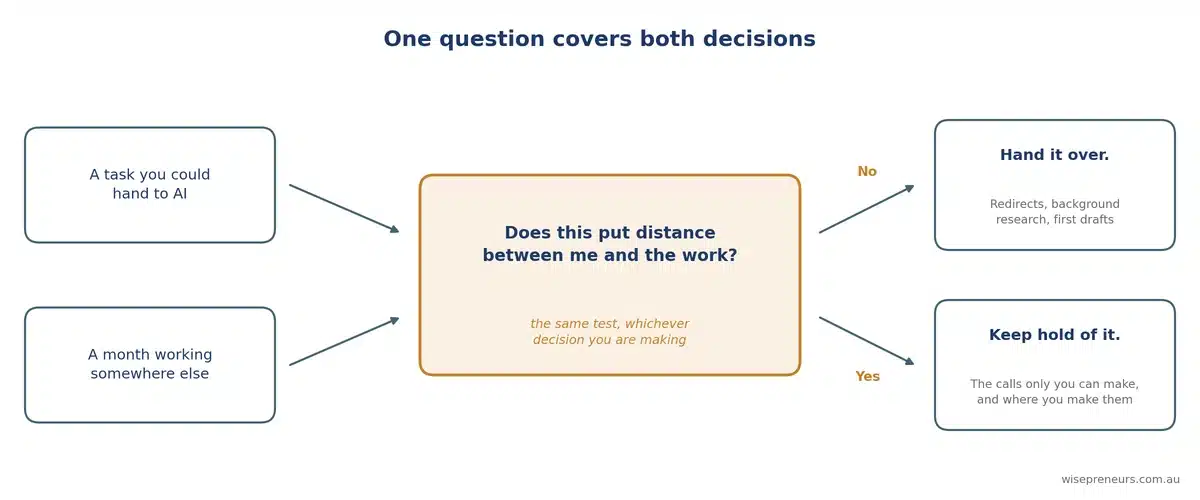
Here's where the two halves of that conversation meet. Moving your work to another country and handing a task to a model look like completely different decisions. They're the same decision made twice, because both change the system you think with.
When I'm working out what to hand over, the question I use is whether removing it puts distance between me and the texture of the work.
- Not whether it saves time, because it always saves time.
- Not whether the output is adequate, because it usually is.
- Distance from the work is the cost that never shows up on the invoice.
Applied to a task, that means asking whether doing it myself maintains something I can't afford to lose.
Most research and most first drafts don't, so AI does plenty of both.
I spent a while trying to get AI to write the schema markup (sort of coding for SEO) for a client's pages, and it just didn't work properly a lot of the time. What it did do was help me understand what the schema needed to be, and that was enough to work out that a hundred dollar plugin would do the job properly.
Paying a developer would have cost many times that. So AI can be very helpful even when it isn't the thing that solves the problem.
Reading four papers and deciding which two matter for this client in this quarter is the other kind of task, and verifying which ideas are worth pursuing has become the scarce thing now that generating them costs almost nothing.
Here is what that protects. Writing an article a while back, AI handed me a quote attributed to one of my podcast guests. I knew straight away they hadn't said it, because the words were mine. I'd said them in the conversation.
It read perfectly well. Nobody who wasn't in that room could have caught it.
Applied to a place, the same question flips the usual framing. A month somewhere else that gets you walking, thinking in longer arcs and sitting in rooms with people who see your field differently brings you closer to the work, because you come back seeing your own practice more clearly.
A month somewhere else with bad internet, no desk and the same to-do list leaves you further from the work than when you left.
There's a second check worth running on any tool you've used for a while, and it takes about ten seconds.
Do you still notice it? A tool you've stopped seeing is a tool nobody is governing, because there's no longer a moment where anyone decides anything.
The practice is to make it visible again on purpose: draft your own answer before you ask, get it to show its working, do the occasional piece the long way. That's slower, and being slower is the whole point, in the same way that lifting the weight yourself is the point of the weight room.
One question I put to Filip was never fully resolved. If a generalist with AI can do an expert's job, what happens to expertise?
And for me, the answer is that it moves to the part that can't be handed over. The work goes out under my name, and some of what's in it started as a draft I didn't write. If it's wrong, it's mine to answer for, and I'm the one who has to catch it before the client does. That needs me close enough to the work to be able to tell.
Next steps
Pick one task you handed to AI in the last six months and do the next instance of it yourself, start to finish, before you look at what the model says. Then compare. If your version was worse in ways you can name, the delegation was sound. If you couldn't produce a version at all, you've found something worth taking back.
If you want a structured way through that, the Wisepreneur's Automaticity Audit works through which tasks have genuinely become automatic for you, and which ones only look that way because something else is doing them.
Frequently asked questions
How do I use AI tools for independent consultants without losing my own expertise?
Keep AI on the tasks where doing them yourself wouldn't maintain anything, and keep yourself on the tasks that hold you in contact with the material. Draft your own analysis before you ask, get the model to show its reasoning so you can evaluate it, and periodically do a piece of work the long way to check your own capability is still there. The test is whether you could still tell if the output was wrong.
I've been doing this work for 30 years. Does AI make that experience worth less?
The evidence points the other way for people working for themselves. As generating options gets cheaper, the scarce capability becomes deciding which option fits this client in this situation, which is built from having seen similar calls play out before. The real risk is that you stop exercising that capability and it fades at exactly the point its market value is rising.
What is the difference between augmenting my work with AI and automating it?
Augmenting means using AI to raise the standard of work you're still doing, so you stay in the loop and keep building capability. Automating means handing a task over entirely, which is fine for genuinely routine processing and expensive when the task was teaching you something you hadn't noticed. The useful question before delegating anything is whether performing it generates learning that improves your work elsewhere.
Does working from anywhere actually improve how I think?
Changing where you work changes what you notice, because familiar surroundings let your habits run without interruption and unfamiliar ones don't. The effect doesn't depend on distance, which is why Filip Drimalka points people to their nearest coworking space rather than to a destination. The gain only holds if your working conditions travel with you.
References
Filip Drimalka The Future of No Work: AI Tools for Independent Professional Practice.Wisepreneurs Project podcast, Episode 67, on AI as an extension of thinking, the mindset behind AI fluency, workations, and what happens to expertise when generalists gain access to expert-level tools.
Filip Drimalka - The Future of No Work (2023). Czech technologist and founder whose framework for deciding what you author yourself, what you review, and what AI handles alone underpins this article's argument about delegation.
Michael Caosun and Sinan Aral - "The Augmentation Trap: AI Productivity and the Cost of Cognitive Offloading," MIT Sloan, 2026. Models the conditions under which adopting AI is individually rational and still leaves the worker less capable, and shows that self-directed professionals are structurally protected from it.
Andrew Heiss - position paper on AI and desirable difficulties, Toronto Data Workshop, 2026. Collects the measured evidence on skill erosion, including Bastani et al. (2025, PNAS) on high school maths students and Shen and Tamkin (2026) on developers learning an unfamiliar library.
B. Scot Rousse and Massimo Scapini - "The Fate of Expertise in the Age of AI," Journal of Expertise, Vol 9 Issue 2, 2026. Argues that AI gives untrained people an elevator past the lower rungs of skill acquisition, destabilising the ladder that produces experts, and that expertise mutates into responsibility for work you did not personally execute.
Nick Bloom - research on remote and hybrid work productivity, Stanford. The source for the finding that fully remote work is mildly negative on productivity on average, with mentoring and knowledge transfer the first casualties.
Every Tuesday I send The Wisepreneur, a short letter for experienced professionals building independent practice: one usable idea a week. Sign up at wisepreneurs.com.au/newsletter
When you want a second pair of eyes on your own practice, the Positioning and Practice Audit is how I work with people: wisepreneurs.com.au/marketing-partnership