
At a glance: Deciding which work goes to the model and which stays with you.
I spend a few hundred dollars a month on AI, and measure that cost against the five lines of my business.
While the price of drafting keeps falling, the person who knows which answer is wrong hasn't got any cheaper.
So the useful skill is not using AI more. It is deciding which work goes to the model and which stays with you.
This article walks through the six moves for doing that, from sorting your recurring work into two columns to redrawing the line on purpose each quarter.
The price of drafting keeps falling. The person who knows which answer is wrong hasn't got any cheaper.
I spend more than $200 USD a month on AI. That's roughly $300 in Australian dollars, and a fair bit of it goes on just getting things set up right and experimenting. The point of all of it is still knowing what good looks like, and catching the answer that isn't good.
My late mentor, Denis Hitchens, taught me to read a business in five lines: revenue, cost of goods sold, cost of selling, cost of running the business, and profit. I use AI for client work, marketing and running the business, so the cost lands across a few of those lines. But unless it's producing revenue, which it isn't at the moment, it comes out of profit.
When you run a business and can read the five lines of it, $300 a month is a big cost. It's worth it only if it puts more on the revenue line than it takes off profit.
If you're starting out, a number like that could frighten you off the whole idea, and I understand why. You don't need to spend anything like it to start. Most of what follows begins with a sheet of paper and costs nothing. Whatever you spend, $20 or $300, the number to watch is what comes back on the revenue line.
And the price of the models themselves keeps dropping. OpenAI, the company behind ChatGPT, holds an event called DevDay where it announces its new models and what they'll cost to use. Nate, a newsletter writer who follows AI closely and writes about what's actually usable in day-to-day work, covered this year's on 3 October. He noted that the new cheaper model, Sol, comes in at "one-fifth of Astra's standard input and output token prices." (AI companies charge by the token, roughly a chunk of a word, so that's the price of everything you send in and get back.)
A fifth of the price for work that's close to the same standard. That's the number that gets passed around.
The comment in the same piece that matters more to you and me sits further down:
A lot of AI use still depends on one person doing the explaining. That person knows the history, knows which answer is wrong, and knows the exception that makes the obvious solution inappropriate.
If you sell what you know, that person is you. Cheap AI is now built into the email, word processor and phone you already use, and the price of drafting keeps falling. The person who knows which answer is wrong hasn't got any cheaper.
My own $300 answers to the same test. It's money well spent only when the model takes the drafting off my hands and I put the time it frees into the part that doesn't get cheaper: knowing what good looks like for this client, with their history and their budget.
So the useful skill now is deciding which work goes to the model and which stays with you. Here's a way to work through it, with what I do in my own practice as the worked example.
Start with a list of the work you repeat
Consider sitting down once, with a sheet of paper or a blank note, and listing the work you do every week or every month. The recurring stuff, the jobs that come round again whether you plan for them or not. Then sort that list into two columns.
The first column is mechanical: filing, first drafts, summarising a long document, formatting a report, turning meeting notes into an actionable checklist. You know what finished looks like for these jobs, and you could hand them to a capable assistant with a two-line brief.
The second column is the judgment work, and it helps to be specific about what that means. It's the final read before something goes to a client. It's the call about whether a recommendation fits this client, with their budget, their board and their history. And it's the moment you look at a confident answer and think, "That doesn't match what I know."
Sangeet Choudary puts it this way:
Judgment is knowing what good looks like – even when you can't put a number on it.
Don't expect the sort to be clean. Some jobs straddle both columns. A client report might be mostly mechanical assembly plus one paragraph where you tell the client what it all means for them. Split it, so the assembly goes in the first column and the paragraph goes in the second.
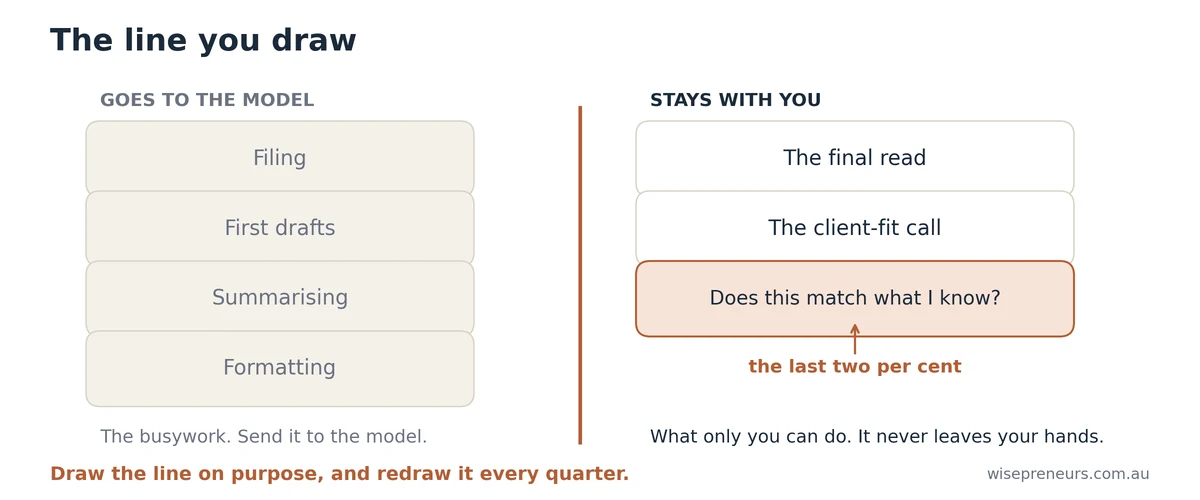
The line you draw. Most of the work goes to the model; the last two per cent stays with you. Redraw it on purpose every quarter.
Send the busywork to the cheap model
Once you have the two columns, the routing more or less writes itself. The mechanical column goes to a model. The judgment column stays with you.
Nate says it neatly:
Model choice becomes part of managing how much I can get done.
Paying top-tier prices to have a top-tier model reformat a spreadsheet is like paying a senior partner's hourly rate to do the photocopying.
Within the mechanical column there are still tiers. Here's how I route my own work. I use my models through Hermes, which runs on three rails: scheduled jobs that fire on their own, one-line prompts to the cheapest model, and subtasks delegated in the background.
The brief stays short because I've already written down 'what finished looks like' as a reusable procedure (skills), so Hermes knows the shape of the answer before it starts. The cheapest but most capable model I use acts as my COO, handling the repetitive tasks (filing, research, transcriptions) and triaging the first drafts. I use several other models depending on the task. When the work needs more care, I move up to a dearer model, sometimes two, and anything client-facing goes through a model I've tuned for the job.
The judgment column works the other way. I don't hand it off, but I do bring a second model in to argue with whatever I'm about to commit to. When I'm thinking through strategy, I ask the dearer model to argue a case and read what comes back. Then I weigh it against what I know about the client and the situation, and decide whether anything changes. The decision, and my name on it, stays with me.
That's the pattern across the whole setup. The models draft, dig and push back. I look at what comes back and decide.
I've set out this routing in AI for independent professionals, on staying the expert in the room as the tools get smarter.
Check what the work actually costs
Here's where it gets slippery. The sticker price per token is one thing. What you pay for the finished job is another.
Cheaper models can burn through far more reasoning to reach the same answer. A summary of research by Lingjiao Chen reports cases where the cheaper model ended up costing many times more than the dearer one for the same task, with figures of up to around 28 times quoted, and the reversal turning up in something like a quarter of the cases tested. I haven't checked those numbers against the paper itself, so treat them as reported rather than settled.
The pattern underneath them holds up well enough. A cheap model that goes round in circles is an expensive model.
Subscription plans have their own version of this. Some tiers swap you to a weaker model partway through the month once you've used up your allowance, without much of a signal that it's happened. The work keeps coming back. It just comes back from a weaker model than the one you chose.
So consider watching usage rather than price. Where your provider shows what each job consumed, look at it once a month. And when the answers suddenly get thinner or sloppier late in the month, check which model you're actually talking to before you blame your prompt.
Watch usage, not price
A cheap model that goes round in circles is an expensive model. Some plans swap you to a weaker model partway through the month without a clear signal. When the answers get thinner, check which model you're actually talking to before you blame your prompt.
I read every one of these costs the way I read any other, across the five lines of the business.
Name what you won't hand over, before you start
This is the move I'd put the most care into.
Before you start routing, write down the one thing the model can't give you. Nate's version is the person doing the explaining, the one who "knows which answer is wrong". My own version is what I call the last two per cent: the final pass where I read what the model has produced against what I already know about this client and ask whether it fits.
A model can tell you a lot about a client's industry. It can't tell you that this client tried exactly that approach two years ago and it went badly, or that the person signing off can't stand anything that sounds like a sales pitch. You carry that.
Writing it down in advance matters because the drift happens one small handover at a time. A summary you didn't check. A draft that went out because it read well. Each one feels harmless on the day, and you only see the pattern when you add them up.
Be clear about what this list is for. Naming the last two per cent tells you exactly where you stand behind the result, so you can send the rest without pretending the model owns it. It's how you steer. The more clearly you know which part is yours, the more freely you can give the model the rest.
The how-to is in how to work with AI without losing your expertise.
Follow the scarcity
Choudary's advice is to "follow the scarcity". When something becomes abundant, its value drains away, and the value moves to whatever is still in short supply. Drafts, summaries and first-pass research are abundant now. Anyone with a subscription can produce them in volume.
What's still in short supply is the work you're paid for: reading the situation in front of you, choosing which of several defensible options fits this particular client, and standing behind the result when it's put to the test. A client can't get those by pasting their problem into a chat window.
I've made this argument before in why ideas are now almost free and your judgment is the scarce part.
He also warns that "winning the wrong game is losing." If you use AI to produce more of the abundant stuff, faster, you can look very busy and still be competing on the part of the work that gets cheaper every month.
Nate makes a similar point about the tools themselves: "Form factor is converging. Utility is not." The chat windows are starting to look alike. What you do with them, and what you do that they can't, is where the difference shows up for a client.
A way to work with this: when routing mechanical jobs to a model frees up a few hours, consider where those hours go. Pour them into more mechanical work and you've won the wrong game. Put them into a longer conversation with a client about what's really bothering them, and you're spending them on the scarce part.
Redraw the line on purpose
The line between your two columns won't stay put. Every few months a cheaper model gets better at something that used to need the dear one, and a job that sat in your second column starts to look mechanical.
That's fine, and it's part of the point. The risk is letting the line move without noticing. You start trusting the cheap model's summary of a contract because it was right the last five times, and one day it misses the clause that mattered.
So consider putting a date in your diary every quarter to look at the two columns again. Ask three questions of each job. Has a model got good enough to take this on? Has anything gone wrong that says it should come back to me? And has anything crept into the second column that I didn't expect?
Some jobs will move across. Some will move back. What you're after is a line you drew on purpose, rather than one that drifted while you were busy.
The model prices will keep dropping. What you know about your clients, and your sense of what good looks like for them, doesn't get cheaper, because it's built from doing the work with them, and you're the one doing it.
I've gathered the longer pieces on working with AI as a thinking partner in one place, if you want to go further.
Next steps
This week, write down ten pieces of work you did last week and put an M or a J beside each one: M for mechanical, J for the work where you check the answer against what you know about the client.
That sheet of paper is your line. The model prices will be lower again in three months, when you take it out and redraw it on purpose.
Frequently asked questions
Which work should I hand to AI and which should I keep?
Sort your recurring work into two columns. The mechanical work – filing, first drafts, summarising, formatting – goes to the model. The judgment work – the final read, the call about whether this fits this client, the moment a confident answer doesn't match what you know – stays with you. The line between the two moves as the tools get better, so redraw it on purpose every quarter.
Isn't a cheaper model just as good?
Sometimes, and sometimes the opposite. A cheap model can burn far more reasoning to reach the same answer, and some plans swap you to a weaker model partway through the month. Watch usage, not the sticker price, and check which model you're actually talking to when the answers get thinner.
Will handing work to AI make me worse at my job?
Only if you hand over the thinking itself and stop checking. The protection is to name, in advance, the one thing the model can't supply – knowing which answer doesn't match what you know about this client – and keep that in your own hands. Give the model the busywork, and keep the last two per cent.
References
Nate - "Hitting your ChatGPT limit? Try Sol before paying $300 more", Nate's Newsletter (Substack), 3 October 2026. The source of the "one person doing the explaining" line, "form factor is converging, utility is not", and the Sol one-fifth price figure.
Sangeet Choudary - Reshuffle, "Follow the scarcity" (Infinite Loops podcast). The source of "judgment is knowing what good looks like", "follow the scarcity", and "winning the wrong game is losing".
Lingjiao Chen - research on model pricing, summarised in the AI token-costs source note, on cheaper models consuming far more reasoning and occasionally costing many times more than the dearer model for the same task. Figures reported as second-hand and treated as approximate, not verified against the primary paper.
Every Tuesday I send The Wisepreneur, a short letter for experienced professionals building independent practice: one usable idea a week. Sign up at wisepreneurs.com.au/newsletter
When you want a second pair of eyes on your own practice, the Positioning and Practice Audit is how I work with people: wisepreneurs.com.au/marketing-partnership