
At a glance: Your expertise is a living system — small, consistent daily steps keep it sharp, while neglect quietly thins it.
Physician Peter Attia, in his book Outlive, points to a striking finding about physical health.
Moving from no exercise at all to about ninety minutes a week lowers your risk of dying from any cause by roughly fourteen percent.
The largest return comes from the shift between nothing and something.
The same shape holds for your professional cognitive system, with consequences most experienced professionals never stop to examine.
The pattern recognition and contextual judgment you built through decades of practice run on a living architecture, one that compounds through consistent engagement and atrophies through neglect.
Small daily steps are the ordinary maintenance of the infrastructure that generates your professional value.
The shift from nothing to something is where the compounding begins. Ordinary, consistent engagement with the substance of your domain outperforms dramatic reinvention and heroic effort, because it is the only kind you actually sustain.
The compounding logic of expertise maintenance
The conventional productivity story focuses on output: how much you produce in a given period.
For wisepreneurs whose value rests on accumulated expertise, that framing misses the deeper dynamic.
Every hour you spend engaged with the substance of your domain does two things at once. It produces work, and it maintains the cognitive system that makes your future work possible.
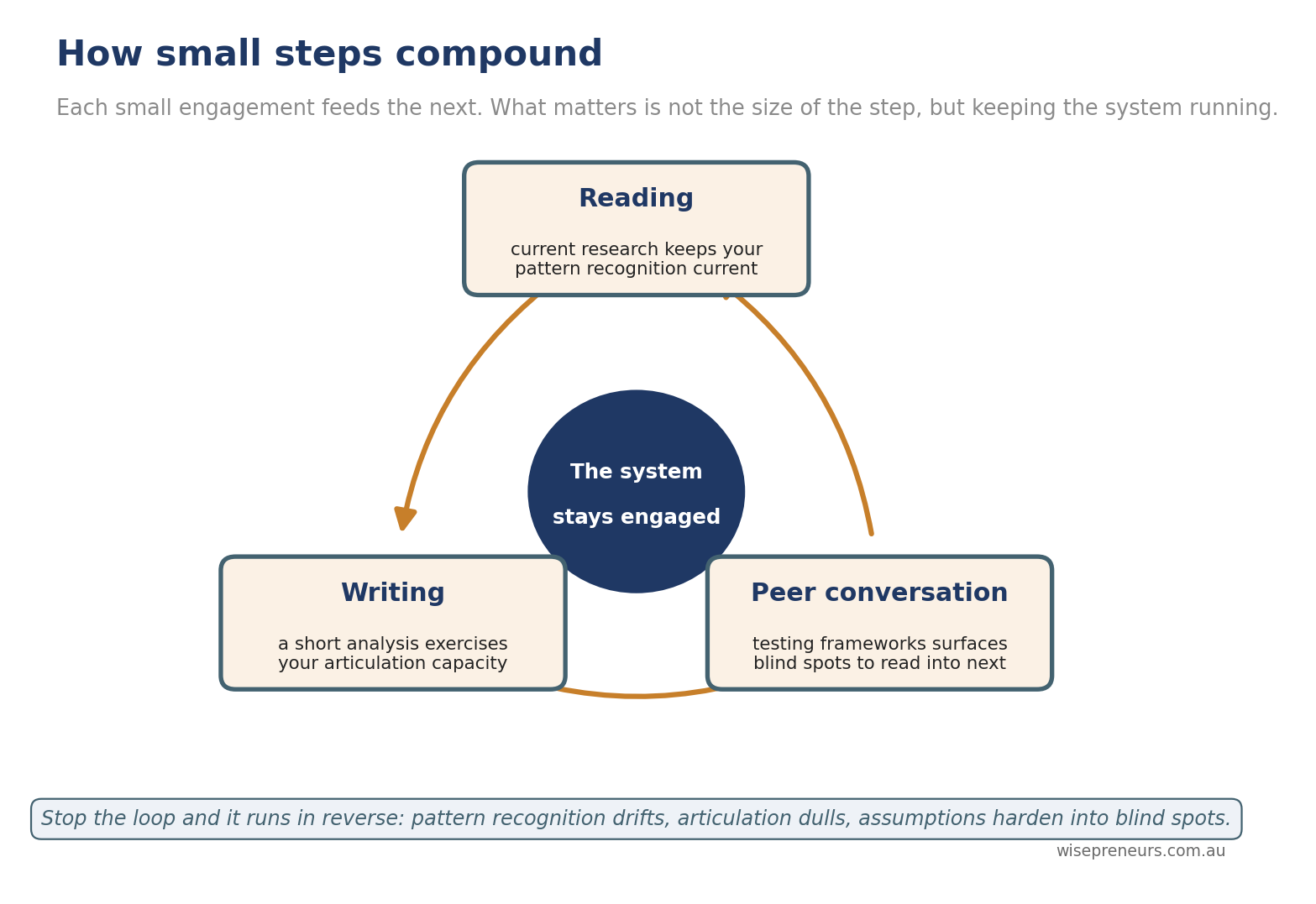
Thirty minutes reading current research keeps the associative networks behind your pattern recognition current with the field. A short written analysis of a problem you have just met exercises the articulation capacity that makes your expertise legible to clients.
A substantive conversation with a peer about an emerging trend tests your frameworks against someone else's experience and sharpens your productive mindware in the process.
Each of these is small. Each also feeds the others.
That mutual feeding is where the compounding lives. The reading sharpens the pattern recognition that makes the writing more insightful. The writing clarifies the thinking that makes the peer conversation more productive. The peer conversation surfaces blind spots that direct the next round of reading. None of it needs to be large. What matters is that the system stays engaged.
The drift compounds in the same quiet way, in reverse. Stop reading in your field and your pattern recognition slowly loses touch with current reality. Stop writing about your domain and your articulation capacity dulls. Stop engaging with peers and your frameworks go untested while your assumptions harden into blind spots. Day to day the decline is invisible. Over months it becomes substantial.
What counts as a step
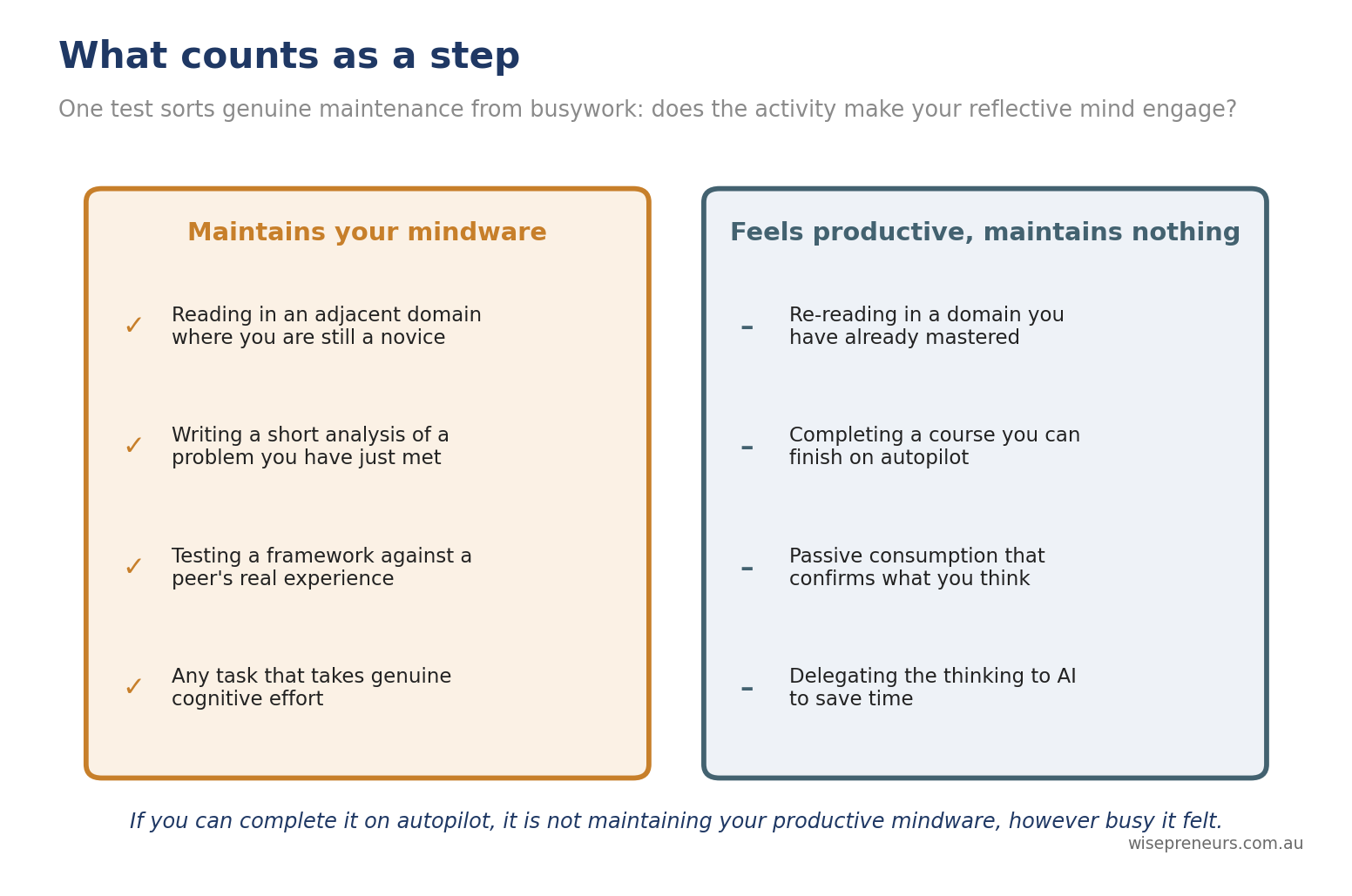
The steps that maintain a wisepreneur's expertise sit apart from the generic menu of professional development. A conference, an online course, or a business bestseller may or may not maintain your productive mindware. The test is whether the activity engages your specific cognitive system with genuine challenge.
Keith Stanovich's work is useful here. Your productive mindware is the set of thinking dispositions, strategies, and knowledge structures your reflective mind has accumulated through deliberate practice. The activities that maintain it are the ones that make your reflective mind engage, rather than the ones you can complete on autopilot.
Reading a book in a domain you have already mastered can feel productive while barely stretching your cognitive system. Reading in an adjacent domain, where you are still a novice, activates the circuits tied to cognitive flexibility and sustained learning. The companion article on cognitive maintenance identifies sustained effortful learning as one of four maintenance domains for exactly this reason: genuine difficulty is what keeps the system plastic. Coast on existing patterns and you stop generating new ones.
In my own practice I keep time each day for material that challenges my thinking. Industry trends, certainly, and also books and podcasts well outside my immediate domain. The reading and note-taking that goes with it is active construction rather than passive consumption: connecting ideas across sources, testing frameworks against new material, building the associative networks that generate the insights my clients and audience need. Most sessions produce nothing visible. Every session maintains the system that produces something visible when it counts.
The end-of-day test. Ask one question at the end of the day: did I engage my reflective mind with something that took genuine cognitive effort? If you can finish the activity on autopilot, it is not maintaining your productive mindware, however busy it felt.
Augmentation over automation in daily practice
AI makes it tempting to shortcut the daily maintenance work. Why spend thirty minutes researching a topic when a model can synthesise it in seconds? Why draft your own analysis when it can produce one? Why prepare your own notes before a peer conversation when it can brief you instantly?
The answer runs straight through the augmentation trap, which I covered in the paradox of expertise. Delegating a task to AI because it looks efficient may give you an adequate output. If that same task was also keeping you engaged with the substance of your domain, the delegation does invisible damage. Month by month your feel for the area thins, your judgment loses depth, and eventually you cannot tell whether the AI's output is any good, because you have lost the contextual depth the judgment required. This is the verification bottleneck at close range: when generation gets cheap, the scarce capacity is the verification work your reading of a situation does, and that capacity is maintained by exactly the engagement you were tempted to delegate.
The discipline is augmentation over automation. Use AI to accelerate research you then weigh against your own domain knowledge. Use it for first drafts you then reshape with your professional judgment. Use it to surface patterns you then read through your accumulated experience. Michael Caosun and Sinan Aral's research makes the boundary precise: the augmentation trap binds hardest when someone else controls how intensively you use AI and works to a shorter horizon than your career. When you control your own usage, you balance today's productivity against the judgment tomorrow depends on.
Self-directed professionals hold a structural advantage here. You decide which tasks to delegate and which to protect as cognitive maintenance. No organisational policy forces you to automate the work that keeps your expertise sharp. The advantage only pays out if you use it deliberately. The question to hold before every delegation is whether the task maintains something in your cognitive system you cannot afford to lose.
The self-direction advantage in your daily rhythm
Wisepreneurs control something employees rarely do: the conditions their cognitive system runs under. You can build movement into the working day instead of sitting through eight-hour blocks. You can protect sleep instead of trading it against an artificial deadline. You can set aside time for the sustained effortful learning that keeps the mind plastic.
Krisna Hanks spent thirty-three years as a professional dancer before becoming a health coach and executive wellness specialist, and she has joined me on the Wisepreneurs podcast twice. Her framing cuts through the wellness noise.
In dance, if the body stops working, the work stops and the rent goes unpaid, so you learn early that maintaining the instrument is the work rather than a break from it.
That translates directly to knowledge work, where your cognitive system is the instrument you practise through. Hanks points to a trap specific to people who do deep work: you can complete your structured exercise perfectly, then cancel part of the benefit by sitting for hours at the desk.
She calls it the active couch potato phenomenon, and her remedy is what she calls metabolic sparks, regular changes in posture, position, and movement intensity across the day.
This is where the physical small steps meet the cognitive ones. Your productive mindware runs on biological infrastructure. Brief walks between deep work sessions, standing during phone calls, a change of working position through the day: these sustain the metabolic conditions that pattern recognition and sustained attention depend on. They keep your sovereign core working at capacity.
Dr Holly Whelan, a neuroscientist and behaviour change specialist on the podcast, puts the foundation in numbers. Around seventy percent of health outcomes track to lifestyle and habits rather than genetics, and the mind can stay sharp into your seventies, eighties, and beyond with deliberate maintenance.
For a wisepreneur whose income depends on the quality of cognitive output, those daily steps are the maintenance schedule for the system that generates your commercial value.
The compounding timeline
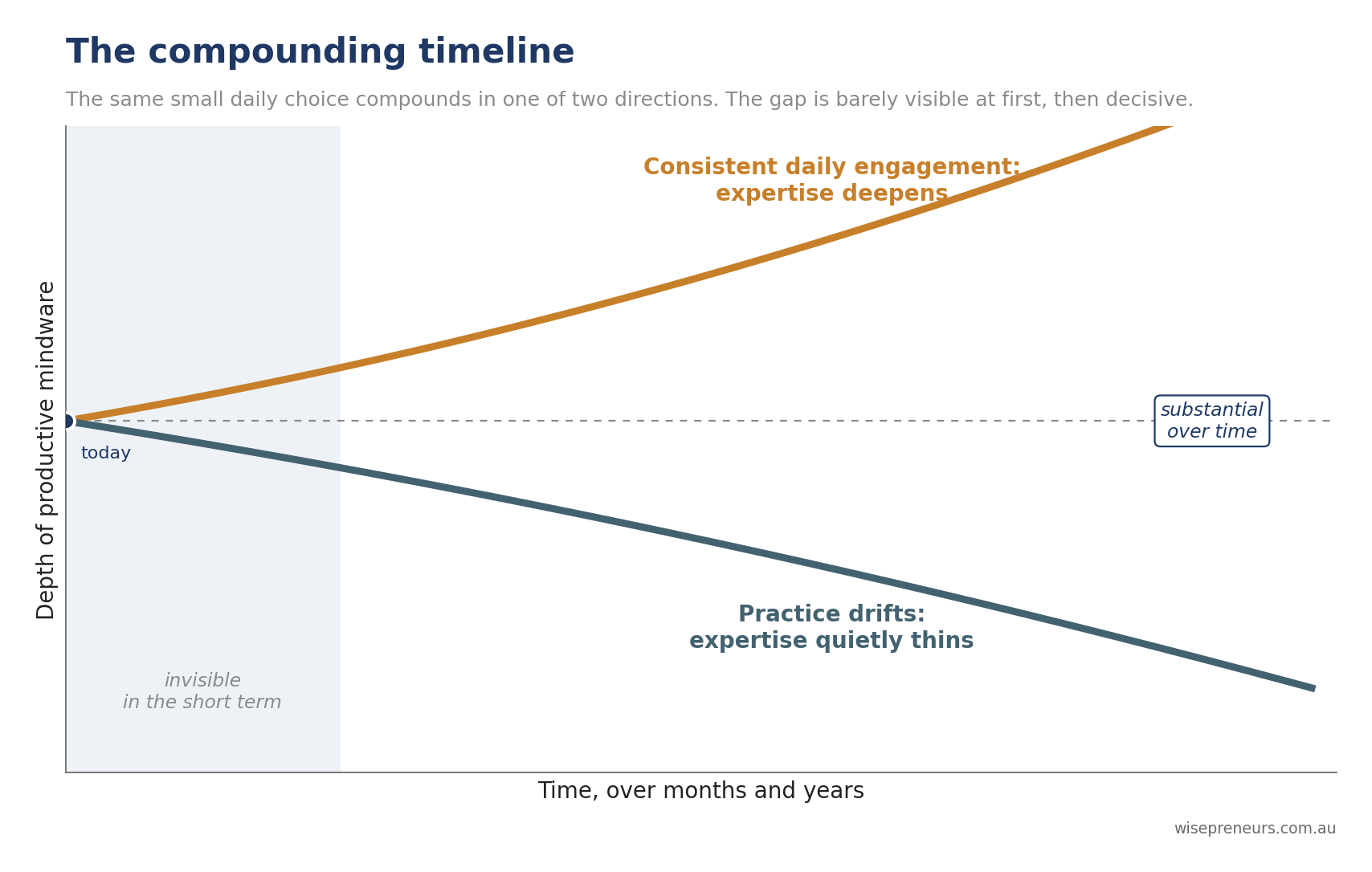
The uncomfortable part is that the effect of a small step stays invisible in the short term. You will not feel the benefit of today's thirty minutes of reading for weeks or months, and you will not feel the cost of skipping it for weeks or months either. That delay is what makes the discipline hard, and it is also what makes it powerful.
The people willing to act before the feedback arrives are the ones who capture the compounding.
Professionals who keep up consistent daily engagement with the substance of their domain compound their expertise over years.
- Their pattern recognition stays current.
- Their articulation capacity stays sharp.
- Their peer relationships stay live.
- Their cognitive system stays plastic enough to form new connections and deep enough to generate the autonomous judgments that justify premium positioning.
Professionals who let the daily practice slide, usually because client work is loud and maintenance feels dispensable, compound in the other direction. Their expertise thins. The gap between their current capacity and their accumulated reputation widens. They lean harder on past patterns and generate fewer new ones. The gap carries a second cost, because keeping your expertise visible only pays when there is something current behind the visibility, and an audience senses thinning long before anyone says so.
Neither trajectory is chosen in a dramatic moment of decision. Each is chosen in the daily allocation of thirty minutes here and an hour there. Small steps, compounding quietly, in one direction or the other.
Thirty minutes of genuine cognitive engagement with the substance of your domain, held steady over years, is the ordinary discipline that compounds into the structural advantage separating deepening expertise from quietly thinning capability.
Luck compounds on the same schedule
Tina Seelig, who teaches at Stanford and has spent years on how people create their own good fortune, separates two things we usually blur together. Fortune is what happens to you: where you were born, the state of your market, who else is in the room.
Luck is the part you influence, through preparing, asking, following up, and staying in touch.
Her central claim is that luck seldom sails solo. It is not a quality stored inside a lucky person, it is what happens between people, which is why the same daily cadence that maintains your expertise also widens the surface where luck can reach you.
The peer conversation that tests your frameworks is also the relationship that, years later, puts your name forward for something you could not have reached cold.
This is compounding of a second kind, and it runs on the same clock. A thank-you to someone who mattered, a note to a former client, a short and specific ask of a person whose work you have actually read: each one is small, none pays off today, and together, held steady over years, they build a relational architecture a professional three years into a career cannot have.
Fortune sets the conditions you did not choose. Luck is the part you compound.
Frequently asked questions
How much time should I spend on daily professional maintenance?
Peter Attia's health analogy is the guide: the move from nothing to something delivers the disproportionate return. Thirty minutes of genuine cognitive engagement daily does more than an occasional intensive study session, because compounding rewards regular input over volume. Build the time around activities that challenge your thinking rather than confirm what you already believe.
Does this apply if I am already busy with client work?
Client work maintains part of your productive mindware, particularly the pattern recognition and contextual judgment that direct engagement exercises. On its own, though, it tends to reinforce existing patterns rather than generate new ones. The reading, writing, and peer engagement outside client delivery are where your cognitive system meets genuine novelty and keeps its plasticity. Protecting time for it is how you keep your client work valuable.
How do I know if my expertise is compounding or thinning?
Two signals. First, are you still meeting ideas in your domain that surprise you and take real effort to integrate? If everything you read confirms what you already think, your engagement has grown too comfortable to keep the system plastic. Second, can you articulate your expertise more clearly now than a year ago? A sharpening ability to name what your productive mindware does is the sign it is compounding. A growing struggle to explain what you do differently is the sign the daily practice needs redirecting.
References
- Peter Attia, Outlive: The Science and Art of Longevity (2023). The disproportionate return of moving from no activity to a consistent small amount, applied here to professional cognitive maintenance.
- Chi Pang Wen and colleagues, 'Minimum amount of physical activity for reduced mortality and extended life expectancy: a prospective cohort study' (The Lancet, 2011). The primary source of the fourteen percent figure: about ninety minutes a week of moderate activity, associated with a fourteen percent lower risk of all-cause mortality and roughly three added years of life expectancy.
- Keith Stanovich, What Intelligence Tests Miss: The Psychology of Rational Thought (2009). The productive mindware framework that distinguishes tested expertise from untested assumption.
- Michael Caosun and Sinan Aral, The Augmentation Trap: AI Productivity and the Cost of Cognitive Offloading (2026). How self-directed professionals are structurally protected from expertise erosion when they control their own AI usage.
- Tina Seelig, What I Wish I Knew About Luck: A Crash Course on Turning Aspirations into Achievements (HarperOne, 2026). A practitioner's account of luck as small, mostly relational daily actions; the fortune and luck distinction and 'luck seldom sails solo' are hers.
Habits for Life: Dr Holly Whelan on Health, Longevity, and Success.
Wisepreneurs Project podcast, on the seventy percent lifestyle factor and deliberate cognitive maintenance.
Krisna Hanks: From Dance to Dynamic Health Coach.
Wisepreneurs Project podcast, on the active couch potato phenomenon and metabolic sparks for knowledge workers.
Every Tuesday I send The Wisepreneur, a short letter for experienced professionals building independent practice: one usable idea a week. Sign up at wisepreneurs.com.au/newsletter
When you want a second pair of eyes on your own practice, the Positioning and Practice Audit is how I work with people: wisepreneurs.com.au/marketing-partnership