
At a glance: Old success can become a precise source of blindness
Dr Michael Best was 70, more than 50 years into medicine, when a stranger on the other end of the phone told him about something he had never once been taught.
Richard David Hames would call what happened next 'the knowledge that disqualifies'.
Professional unlearning becomes urgent when the conditions that made our knowledge reliable no longer hold.
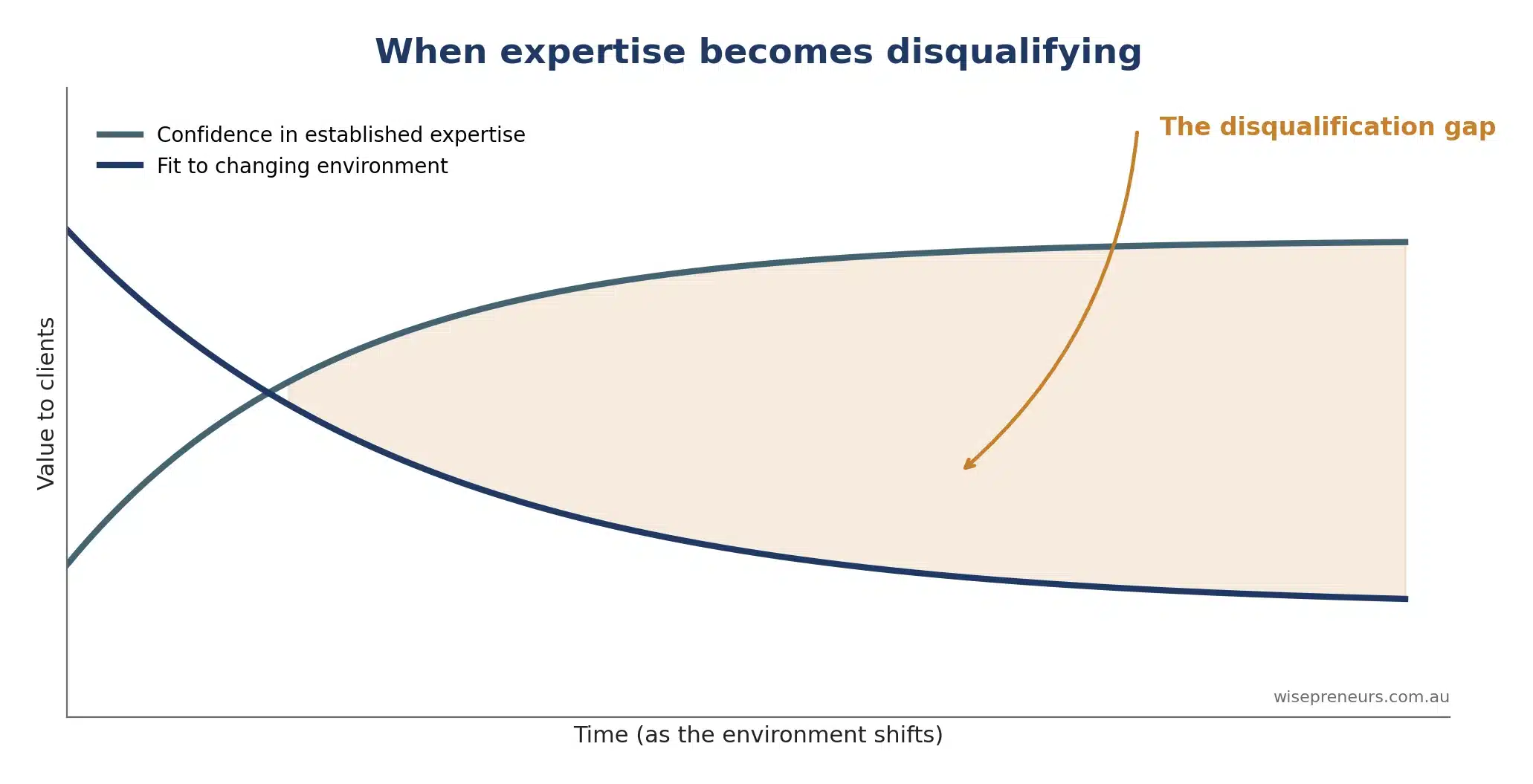
Under genuine discontinuity, a well-developed way of reading a situation can direct us towards the wrong problem with the confidence of long success.
Richard David Hames calls this "the knowledge that disqualifies".
For experienced independent professionals, the answer is to separate durable principles from expired practices, test old assumptions in live situations, and stay close to people who see changes before large institutions do.
The hardest knowledge to release is often the knowledge that has rewarded us most.
Professional unlearning asks experienced practitioners to notice when a reliable map no longer covers the territory — and to suspend the status that says they should already know.
Dr Michael Best faced that moment at 70, after more than 50 years in medicine. Best had never heard of the endocannabinoid system. The system exists throughout the human body. It helps regulate processes including pain, sleep and responses to stress. Researchers identified its receptors in 1988, yet it had never become part of Best's medical education or working frame.
I'd never heard of the endocannabinoid system until 2020 when I spoke to somebody who I didn't know on the other end of the phone talking about it, and I realised afterwards how come, I mean, I've been a doctor for all these years. How come I knew nothing about this?
Dr Michael Best
Instead, he spent the COVID years reading everything he could find, worked in medicinal cannabis for three and a half years, began writing a book, and at 80 started learning Obsidian, Zotero and AI tools to organise his research.
His story gets us past the usual advice to keep our skills current. Best faced something more unsettling: a gap large enough to make him question the map built across five decades of medical work.
His response shows what professional unlearning looks like in practice. We notice where a reliable map no longer covers the territory, suspend the status that tells us we should already know, and become a learner again.
When a reliable map starts steering us towards the wrong problem
Richard David Hames starts with an admission he attributes to Paul Polman, the former chief executive of Unilever.
The knowledge that qualified Polman for the top job had become the knowledge that disqualified him from knowing what to do next.
Hames's claim is more severe than saying our skills have passed their use-by date.
A skill can be updated.
Disqualifying knowledge can include a whole architecture of assumptions: what counts as evidence, who is allowed to decide, which measures matter, how change happens and where useful knowledge is expected to reside.
This is how someone can remain intelligent, diligent and widely informed while becoming less able to read a changed situation.
The patterns recognised quickly are real patterns from an earlier setting. The questions asked are sensible questions for a market, profession or institution that no longer works in the same way.
Success compounds the problem because it supplied years of evidence that the map was sound.
Our accumulated knowledge still carries enormous value. It lets us hear the evasive phrase in a client meeting, connect a current problem with three earlier cases, or ask what changed just before the numbers moved.
The danger begins when we transfer the conclusion along with the pattern. We recognise a familiar shape and reach for the old response before checking whether the underlying conditions still match.
Disqualifying knowledge
A developed way of reading and acting that once produced good results but now hides a material change in the environment. The problem lies in a mismatch between the map and the conditions, not in a lack of intelligence or effort.
The blind spot may belong to the system
Michael Best's encounter with the endocannabinoid system shows why this problem can't be reduced to personal complacency. His blind spot was produced partly by the institutions that selected what doctors learned, what regulators accepted and what the medical profession treated as legitimate evidence.
That doesn't settle the argument about medicinal cannabis. It does reveal how a credentialled profession can fail to notice knowledge developing outside its accepted channels.
We all collect assumptions in similar ways. A professional association teaches one route to credibility. An employer rewards one kind of manager. A consultancy promotes people who can reproduce its method. The method starts to feel like reality itself.
This is the harder edge of what we might call the recognition problem. Some experienced professionals still create substantial value but struggle to put it into words. Hames points to a different case: parts of what we know may genuinely be working against us. Better positioning won't rescue a method whose operating conditions have disappeared.
An audit therefore needs two questions. What do we notice, ask or connect that remains useful in this situation? Which parts of our method depend on conditions that are no longer present?
Neither question can be deferred to AI. AI can propose alternatives and compare documents, but it can't take responsibility for deciding whether the client in front of us resembles the cases in our past closely enough for the old inference to hold.
Durable principles travel further than familiar practices
Johanna Rothman has worked independently since 1994. She left an organisation that wanted annual plans when the work already required frequent adjustment. Her answer was not to replace one fixed method with another.
I offered principles, not practices, that allowed my clients to say, it's not really a Chinese menu where I choose one from column A and two from column B because A implicates something for column B.
Johanna Rothman
That distinction offers a practical defence against disqualifying knowledge.
A practice tells us what to do: prepare the annual plan, run the standard workshop, use the approved template. A principle helps us work out what to do here: shorten the planning interval when feedback arrives quickly, expose assumptions before committing resources, or involve the people who will live with the consequences.
Rothman's value in a client situation comes from framing the particular problem, clarifying how one choice constrains another and working with the client towards a response that fits. The tools can change without erasing that capacity. The principle still has to be tested, but it travels further than the practice.
What we carry forward | What we keep available for revision |
|---|---|
Principles that explain why an approach works | Practices designed for a former tool, market or institution |
Questions that expose constraints and consequences | Answers that assume the constraints are unchanged |
Pattern libraries drawn from varied cases | Automatic conclusions drawn from a familiar pattern |
Relationships with people who challenge our reading | Status signals that protect our reading from challenge |
Unlearning doesn't require us to discard a career's work. It asks us to break the package open. We can retain the questions, distinctions and causal understanding that continue to explain what happens, while releasing procedures that belonged to a particular time and place.
Adaptive competence is forming away from the centre
Hames makes a second claim. The capacity to respond is moving away from central institutions and towards smaller, relational and place-based networks.
His examples are literal. A valley reorganises its own power supply rather than waiting for the grid. A town that has lost its bank creates credit among neighbours. Local people hold knowledge of soil, water and seasons that a ministry never captured.
The same movement is visible at the scale of independent practice. When connecting with a specialist, client or peer anywhere costs very little, the valuable asset is increasingly the network of people who know our work, trust our conduct and help us interpret what is changing.
A large organisation once supplied offices, credentials, colleagues, distribution and a recognised place in the market. Outside it, we need to build that relational infrastructure deliberately.
This is one reason the independent path can be a rational move towards where adaptive capacity is forming.
Smaller practices hear the client's language before it is compressed into a dashboard. We can change an offer after three revealing conversations rather than waiting for an annual planning cycle.
Independence alone provides no protection. A solo practice can cling to an old method as tightly as a ministry can.
The advantage comes from staying connected to a varied group of clients, peers, referrers and collaborators who let us compare interpretations while the change is happening.
This is also why being known and trusted by the right people matters more than being famous to everyone. The referral network carries context. A person sending work our way knows something about how we think, what the client is facing and why the match may be useful. Each engagement adds another situated case from which the network can learn.
Two signs that we are holding on too tightly
Hames describes two responses when established authority can no longer interpret the world it once directed.
The first is denial dressed as continuity: more of the old response, delivered faster and louder. The institution restructures, rebrands and appoints a task force without changing what it treats as valid knowledge.
At the level of a practice, we might publish more frequently while the offer remains unclear, add more services when buyers no longer value the old category, or explain our method more forcefully when the method is the part that needs examination.
The second response is reaching for force after legitimacy has drained away. In institutions, that can mean tighter control and punishment. In a small practice, the equivalents may be rigid contracts used to compensate for weak trust, pressure applied to reluctant prospects, or status invoked when evidence no longer persuades.
These responses give us a useful self-check:
- Are we doing the old thing louder because it once worked?
- Are we gripping process, status or control harder because people no longer respond as expected?
- What evidence would persuade us that the conditions have changed?
- Who in our network can see something our usual advisers may miss?
- Which principle are we protecting, and which familiar practice have we mistaken for that principle?
The questions are uncomfortable by design. Knowledge that has rewarded us rarely announces when it has become a blindfold.
Unlearning without throwing away what still works
Professional unlearning is a form of discrimination: separating what remains generative from what has become restrictive.
We can start with one live problem rather than attempting to review an entire career.
Write down the response that feels obvious. Then name the conditions that would have to be true for that response to work. Which are observed now, which are inherited from earlier cases, and which have simply never been questioned?
A second step is to seek disconfirming contact. Ask a client who declined, a peer outside the profession, or someone working close to the operational edge. The purpose is to find what our usual circle filters out.
A third step is to protect the principle while varying the practice.
- If the principle is rapid feedback, the annual review may need to become a fortnightly conversation.
- If the principle is evidentiary rigour, the evidence base may need to include signals from patients or operators that the formal system has been slow to study.
- If the principle is client growth, selling hours may need to give way to work that helps the client learn to make the decision without us.
Michael Best didn't discard five decades of medicine when he encountered a system he had never studied. His knowledge of patients, evidence and biological processes gave him ways to investigate the unfamiliar field.
What he released was the assumption that a long medical career had already shown him the relevant boundaries of medicine.
That is the balance. We keep the capacities that help us examine a situation carefully, ask a better question and notice consequential details. We release the parts that insist the new situation must fit the old explanation.
Frequently asked questions
How is disqualifying knowledge different from outdated skills?
An outdated skill is usually bounded and teachable, such as learning new software. Disqualifying knowledge is a wider frame that can direct a capable person towards the wrong problem because their measures, categories and assumptions no longer match current conditions.
How do I know whether my experience is helping or blinding me?
Name the response that feels immediately obvious, then list the conditions that must be true for it to work. If those conditions are inherited rather than observed, test the response with clients, peers and people closer to where the change is occurring.
Does unlearning mean starting again?
No. Unlearning means separating durable principles from practices tied to a former setting. We retain the capacity to frame the problem, notice constraints and connect consequences while changing the procedure used in this case.
Why can independent professionals adapt faster?
Independent professionals can receive unfiltered signals from clients and change an offer or method without a long approval chain. The advantage depends on relational infrastructure: trusted peers, referrers, collaborators and clients who challenge our reading rather than simply confirming it.
References
Wisepreneurs Project podcast, Episode 76, on discovering and studying a major medical blind spot after a 50-year career.
Johanna Rothman Independent Consulting: Principles That Outlast Every Trend
Wisepreneurs Project podcast, Episode 92, on using durable principles to choose practices suited to a client's context.
Richard David Hames - "The Knowledge That Disqualifies", The Hames Report, 7 August 2026, on knowledge becoming disqualifying under discontinuity and adaptive competence moving towards the periphery.
Next steps
Choose one problem in your practice for which the answer feels settled. Write down the assumptions that make that answer sensible, then test one of them with someone who sees the situation from a different position.
The goal is not permanent doubt. It is a more accurate kind of confidence, grounded in the conditions we can observe now rather than the conditions that rewarded us before.
For more on how experienced professionals can keep their thinking responsive, see
- how experience changes thinking in knowledge work,
- the paradox of expertise,
- productive mindware and decision quality, and
- working with AI without losing your capabilities
Wisepreneurs explores how experienced independent professionals position accumulated expertise and build sustainable practice.
Every Tuesday I send The Wisepreneur, a short letter for experienced professionals building independent practice: one usable idea a week. Sign up at wisepreneurs.com.au/newsletter
When you want a second pair of eyes on your own practice, the Positioning and Practice Audit is how I work with people: wisepreneurs.com.au/marketing-partnership