
At a glance: AI compressed what buyers can see, so luck now decides more of the outcome
As people get better at any competitive activity, the gap between the best and the rest narrows, and luck decides more of the outcome. Michael Mauboussin called this the paradox of skill.
A version of it has reached independent professional work. AI has compressed the visible signals of expertise while the underlying difference between an experienced practitioner and a competent generalist stays where it was.
Research covering 49,610 Upwork freelancers shows this commoditisation operates where buyers meet you as a profile and a price, and dissolves where clients arrive through relationship, referral or reputation.
Because luck arrives through other people, the useful response is a small relational practice: a monthly re-contact cadence, asking well, and small deliberate risks.
The ground has shifted, and you are not imagining it. What shifted is what buyers can see.
The proposal was strong. The conversation went well. Three weeks later the client thanked you for your time and went with someone cheaper.
If that scene has become more familiar over the past two years, the explanation matters, because it sits in what buyers can see rather than in what you can do.
As skill converges across a field, luck decides more of the difference between outcomes. That is now true of independent professional work, and understanding why luck matters more as skill converges changes what a sensible response looks like this month.
Why rising skill hands more of the outcome to luck
Michael Mauboussin is an investment strategist who has spent his career untangling skill and luck, and The Success Equation (2012) contains the finding this article is built on. He calls it the paradox of skill.
As people get better at an activity, the gap between the best and the average narrows. And when the spread in skill narrows, luck accounts for more of the difference in outcomes.
He built the case from sport and investing. Olympic finalists finish within fractions of a second of each other because training, selection and preparation have converged at the top.
Professional investors hold the same qualifications, read the same filings and run the same models, so the results that separate them owe more to chance than they did fifty years ago.
His test for whether an activity involves skill at all is blunt: can you lose on purpose? If you can, skill is present.
The counter-intuitive part is the direction. Rising skill makes luck matter more, not less. Better fields produce closer contests, and closer contests are settled by smaller accidents.
AI compressed the visible spread, and only the visible spread
Something with the same shape is now happening to independent professional work, and it pays to be precise about the mechanism, because it is different from Mauboussin’s.
In his version, underlying skill converges upward: the players get better together. AI has not done that. The difference between an experienced practitioner and a competent generalist stays exactly where it was. Thirty years of watching recommendations survive or fail inside real organisations has not leaked into anyone else’s hands.
From the outside, a buyer judges you on the glossy proposal, the confident summary, the well-structured report. A competent generalist with good tools now produces a plausible version of all three. That is the visible spread closing, and from the buyer’s side of the table the field looks far more even than it is.
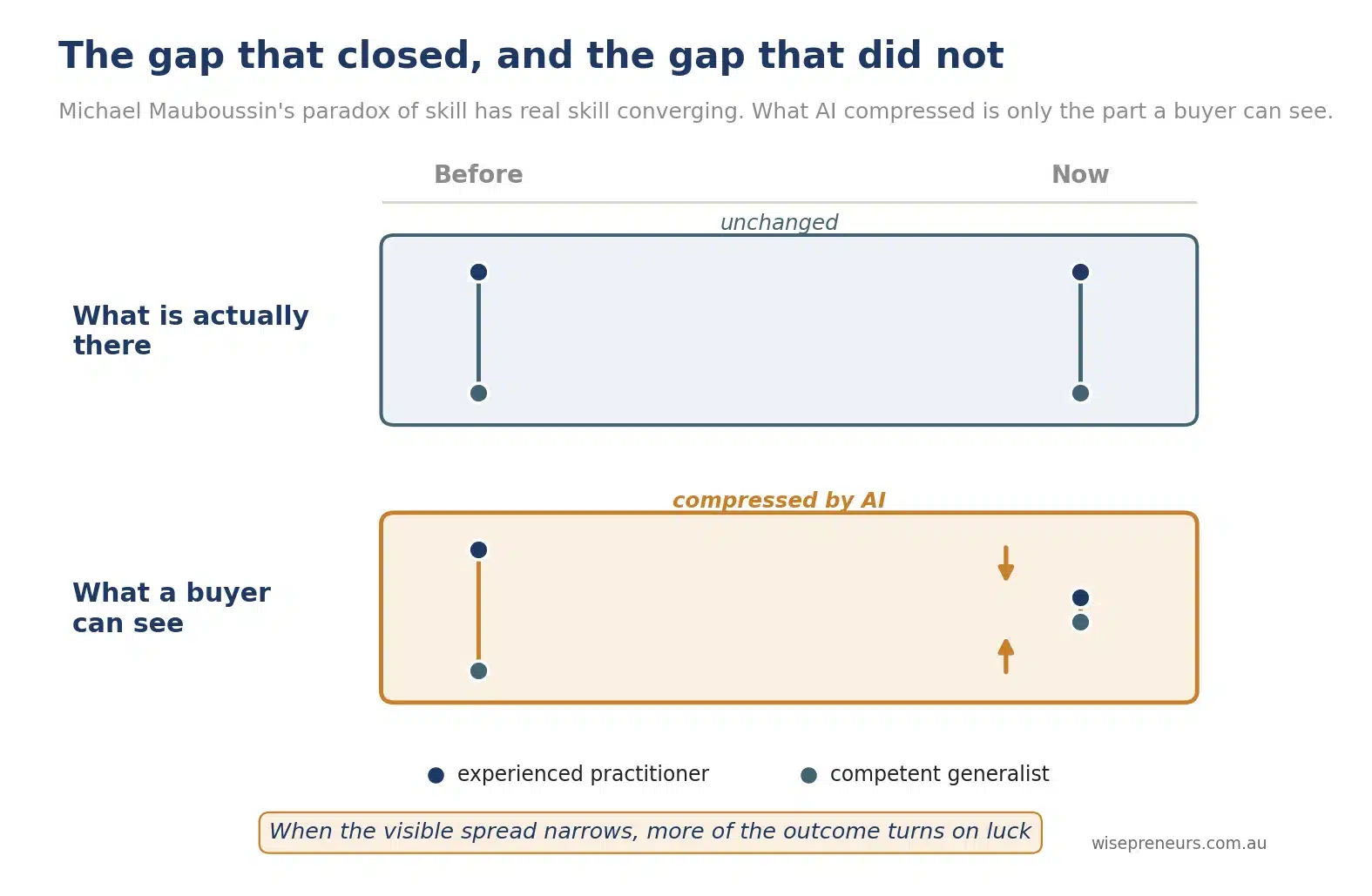
The gap that closed is the one buyers can see. Michael Mauboussin’s paradox of skill supplies the mechanism.
The evidence that the visible spread has narrowed is measured. Siddiq and Zhang studied 49,610 freelancers and 2.26 million contracts on Upwork across the release of ChatGPT. In AI-exposed categories, the market’s valuation of human capital signals, the credentials and history and ratings professionals spend years building, fell about 7.8 per cent. Price sensitivity rose, and demand moved toward cheaper workers. I go into more detail of that study in AI wants to make you interchangeable.
Their scope condition is the hinge of this whole argument. The effect operates in signal-mediated markets, where a buyer meets a supplier as a profile and a price. It dissolves where the client arrives through relationship, referral or prior reputation. Hold onto that boundary, because the article ends inside it.
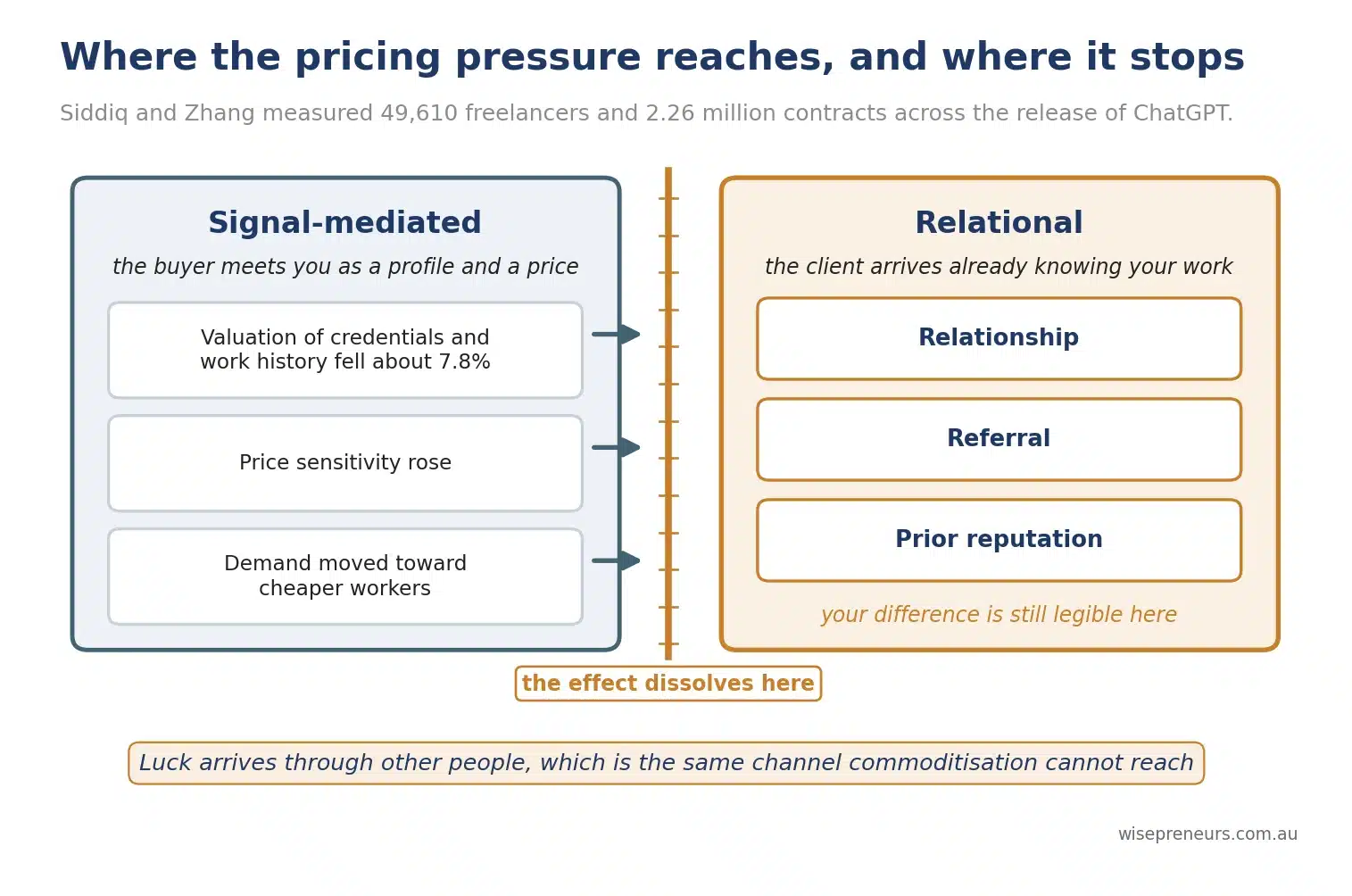
Siddiq and Zhang found the effect dissolves where the client arrives through relationship, referral or prior reputation.
The ground has shifted, and you are not imagining it
Three structural conditions are real and worth naming.
Commoditisation in signal-mediated markets is measured; the numbers are above.
The pipeline that develops deep expertise is narrowing, because the routine work that once trained people for judgment is being automated away. And age discrimination in hiring is real and persistent, which is part of why so many experienced professionals build independent practices in the first place.
If you have a real practice and decades behind you, and the ground feels different underfoot, that is an accurate reading of the conditions, and no amount of attitude changes them.
The distinction the rest of this article depends on comes from Tina Seelig: fortune is what happens to you, luck is the part you influence. The three conditions above are fortune. Everything from here on is about luck.
The evidence that luck is a behaviour
If outcomes now turn more on luck, the question that matters is whether luck is workable.
Psychologist Richard Wiseman spent eight years studying hundreds of people who described themselves as exceptionally lucky or unlucky, published as The Luck Factor (2003).
The two groups showed no difference in intelligence. What separated them was behaviour. Lucky people maximise chance opportunities: they meet more people, stay in touch, and act on what turns up.
They listen to hunches, which for an experienced professional usually means acting on pattern recognition built over years. They expect good fortune, which changes how long they persist. And they turn bad luck to good by reframing what happened and taking the long view.
In his follow-up sessions teaching these behaviours, most participants reported measurably luckier lives.
Luck, in this research, reads as behaviour rather than temperament.
Fortune is what happens to you, luck is the part you work
Tina Seelig is the Executive Director of Knight-Hennessy Scholars at Stanford, and her book What I Wish I Knew About Luck (2026) supplies the two moves this argument needs. Her definition of luck is “success or failure apparently caused by chance”, and the word to take note of is 'apparently'.
Pull back the curtain on most lucky breaks and you find the actions that set the stage: the application, the preparation, the thank-you note, the follow-up.
Fortune is what happens to you: where you were born, the state of your market, who else is bidding for the work. Luck is the part you influence.
We’re in a constant dance in our lives between fortune and luck, the things that happened to us and how we respond. But if you really tease them apart, you start seeing the places where you have more agency than you might think.
Tina Seelig
Her second point gives agency (you) a direction. “Luck seldom sails solo.”
Luck is not a property stored inside a lucky person; it arrives through other people.
Two of her stories run on timescales only a long career has. A student stayed in touch with a documentary professor for ten years, sending samples of her work, and when she needed it most, that professor had just been asked to put candidates forward for a role at the White House.
And Seelig behaved well on a trip that fell apart, thought nothing more of it, and fifteen years later discovered the trip leader was one of the people deciding on her current role. Compounding at those horizons is available to you in a way it simply is not available to someone three years into a career.
The channel where your difference is still legible
Put the pieces together and the argument closes on itself. The market where your difference has become hard to see is the signal-mediated one, where you are a profile and a price.
The channel luck arrives through, in Seelig’s account, is other people. And the channel Siddiq and Zhang found commoditisation cannot reach is the same one: relationship, referral, prior reputation.
So the response to the paradox of skill is to work the channel where the difference between you and the competent generalist is still legible, which is the relational one.
Two guests from the Wisepreneurs Podcast make this concrete. Robert Vlach, who has spent twenty years building Europe’s largest freelance community, told me that when his community surveys its members about what makes a freelance business succeed, three factors come up: reliability, a good name, and expertise.
A good name, in his account, is an established association of quality between you and the specific thing you do.
A good name is something ancient and robust. It’s mostly created by other people talking about you behind your back.
Robert Vlach
He puts the build time at five or ten years or more, which is exactly why it cannot be compressed the way a proposal can. I have written more about why professional reputation beats personal branding in an AI world.
Laetitia Vitaud, on her third visit to the podcast, called the network you can genuinely maintain, roughly 150 relationships on anthropologist Robin Dunbar’s estimate, “the most important asset to start a business”.
Her advice was less about meeting new people and more about caring for the ones already there:
The trick is to develop those relationships with care or maintain those relationships with care. And that’s something you need to continue to do all your life.
This connects to the paradox of expertise: deep knowledge on its own has never been enough, and it needs the relationships that put it to work.
More on this theme sits in the relational authority section of the Insight Hub.
The market where you are a profile and a price is the one that stopped being able to see you. The channel where luck arrives is the one that still can.
Next steps
Three moves follow from the argument, and all three are small on purpose.
First, set a monthly re-contact cadence. Write to two or three people you have not spoken to in a year, each with something specific attached: a result they would want to know about, an article that made you think of them, an introduction, or a straight thank you for something that mattered. Seelig ran a workshop testing exactly this, and the detail worth keeping is that a thank-you three years late still opened doors. Her phrase: there’s no statute of limitations. This works by the same logic as Why small steps compound: the discipline of deliberate professional maintenance: each contact is small, repeatable, and compounds.
Second, ask well when you do ask. Seelig’s rules are usable as written. Do your homework and show it, naming the specific article, episode or piece of work you engaged with. Ask for one small, specific thing rather than a general conversation. Keep it short, because the goal of a first message is a second conversation. Follow up, including a thank you. Asking to pick someone’s brain over coffee fails every one of those tests.
Third, take small deliberate risks rather than one large one. Seelig’s observation about venture capitalists is the useful correction here: they look like bold risk takers, and they spend their working lives squeezing risk out through team, product, market and timing. For a practice, that means one stretch this quarter, a talk given, a piece published, a person approached, rather than a reinvention.
If you want a structured look at what your name currently carries, the Professional Reputation Audit is a good place to start.
It is a smaller and stranger instruction than the situation seems to demand. That is the point. The proposal that went to someone cheaper travelled through a channel where you were a profile and a price. The three notes you write this month travel through the other one.
Frequently asked questions
Why does luck matter more for independent professionals as skill converges?
AI has compressed the visible signals of expertise, so an experienced practitioner and a competent generalist look more alike to a buyer than they are. In signal-mediated markets, where buyers meet you as a profile and a price, outcomes turn more on chance, while relationships and referrals still carry the real difference.
Can experienced professionals actually improve their luck?
Richard Wiseman’s eight years of research with hundreds of lucky and unlucky people found luck operates as a set of behaviours: maximising chance opportunities, listening to hunches, expecting good fortune, and turning bad luck to good. For professionals over 50, the most workable version is relational: a monthly re-contact cadence and small, specific, well-made asks.
What did the Upwork research find about AI and freelance work?
Siddiq and Zhang studied 49,610 freelancers and 2.26 million contracts across the release of ChatGPT and found the market’s valuation of human capital signals fell about 7.8 per cent in AI-exposed categories, while price sensitivity rose. The effect operated where buyers hire from profiles and prices, and dissolved where clients arrived through relationship, referral or prior reputation.
References
Podcast episodes
Robert Vlach Professional Reputation: Why Your Good Name Beats Personal Branding.
Wisepreneurs Project podcast, Episode 75, on the good name as an association of quality built mostly by other people, and why it beats personal branding.
Laetitia Vitaud Career Reinvention After 60: Why Your 150 Relationships Beat Startup Capital.
Wisepreneurs Project podcast, Episode 71, on maintained relationships as the founding asset of an independent practice.
Other sources
Michael J. Mauboussin. The Success Equation: Untangling Skill and Luck in Business, Sports, and Investing (Harvard Business Review Press, 2012). Source of the paradox of skill: as skill rises and converges, luck accounts for more of the difference in outcomes.
Richard Wiseman. The Luck Factor (2003). An eight-year study of hundreds of exceptionally lucky and unlucky people, showing luck operates as four learnable behaviours rather than a temperament.
Tina Seelig. What I Wish I Knew About Luck: A Crash Course on Turning Aspirations into Achievements (HarperOne, 2026). The separation of fortune from luck, the relational claim that luck seldom sails solo, the asking rules and the re-contact evidence.
Tina Seelig. Interview on The School of Greatness with Lewis Howes (2026). Source of the block quote on the constant dance between fortune and luck.
Tina Seelig. The little risks you can take to increase your luck, TED Salon: Brightline Initiative (June 2018). The case for small deliberate risks.
Siddiq and Zhang. Human Capital, AI, and Labor Commoditization (UCLA Anderson working paper, 19 June 2026, SSRN 6968139). The measurement of AI-driven commoditisation on Upwork and its signal-mediated market scope condition.
Every Tuesday I send The Wisepreneur, a short letter for experienced professionals building independent practice: one usable idea a week. Sign up at wisepreneurs.com.au/newsletter
When you want a second pair of eyes on your own practice, the Positioning and Practice Audit is how I work with people: wisepreneurs.com.au/marketing-partnership