
At a glance: no single channel carries your practice; the combination, held together by 'and', does
Mark Ritson's answer to the search for the one platform that replaces all others is blunt: there is no killer tool, and there never has been.
Tools work best in combination, each covering the weaknesses of the others.
For an independent professional this settles the "which platform should I be on" question, because the answer was never a single platform.
It is a small number of channels, each doing a job the others cannot, coordinated toward one objective, and the word that holds the arrangement together is "and."
There is no killer tool. There has never been a killer tool. – Mark Ritson
The channel that would end all other channels
Podcasting was going to end blogging. Video was going to end everything. The feed was going to end the website. A new platform or format arrives, and a wave of people announces that this one changes everything and the old ways are finished.
Mark Ritson watched the creator economy make exactly this claim, and answered it with a sentence that applies far beyond creators:
There is no killer tool. There has never been a killer tool.
The new channels are genuinely useful, and Ritson isn't disputing that. What he's dismantling is the search for the one channel that replaces all the others. The shiny object is always oversold, and usually turns out to be about half as good as the person selling it said it was. The calm response is to fit it into a combination, without either rejecting it or treating it as the answer.
Why the combination wins
Ritson names the mechanism, and it is the oldest lesson in marketing: tools work best in combination, each covering the weaknesses of the others. Television plus search beats either alone.
The same principle runs through Les Binet and Peter Field's The Long and the Short of It, the book that shaped how the industry thinks about effectiveness. Their finding was that the long game of creating awareness plus the short game of creating preference beats either apart – and as Ritson puts it, the most important word in the whole book is "the little one beginning with 'a'."
The word is "and".
Creating awareness is the long work of being known and trusted. Creating preference is the specific offer that converts the people who are ready now. One is for the client who might need you next year; the other is for the client who needs you by Friday. Most of your market isn't looking for help this month. A small slice is. You need the long work running so you are the name that comes up when the ready ones go looking, and you need the specific offer there so the ready ones can act.
What this means for one practice
For an independent professional the question is usually asked as "should I be on LinkedIn, or TikTok, or podcasting, or should I write a blog?" The question assumes a choice, and Ritson's principle says the choice is the trap.
No single platform can protect your practice. If LinkedIn changes its algorithm tomorrow morning, your phone shouldn't stop ringing. If you are borrowing a channel rather than owning it, the protection has to be the combination: several channels, each doing a job, none of them load-bearing alone.
For portfolio professionals, Ben Legg put a number on it on the Wisepreneurs podcast. He ran Google's commercial business in Europe before building a portfolio career, and he said only 20 per cent of the work ever gets listed. Thirty per cent finds you online. Fifty per cent comes from networking and word of mouth referrals. Three channels, none of them optional, none of them sufficient on their own.
Where portfolio work actually comes from, on Ben Legg's numbers:
20 per cent listed,
30 per cent found online,
50 per cent from networking and word of mouth.
None of the three is enough on its own, and no one channel is the answer.
A worked example: four layers aimed at one objective
I run my own visibility this way, and it is the clearest worked example I have.
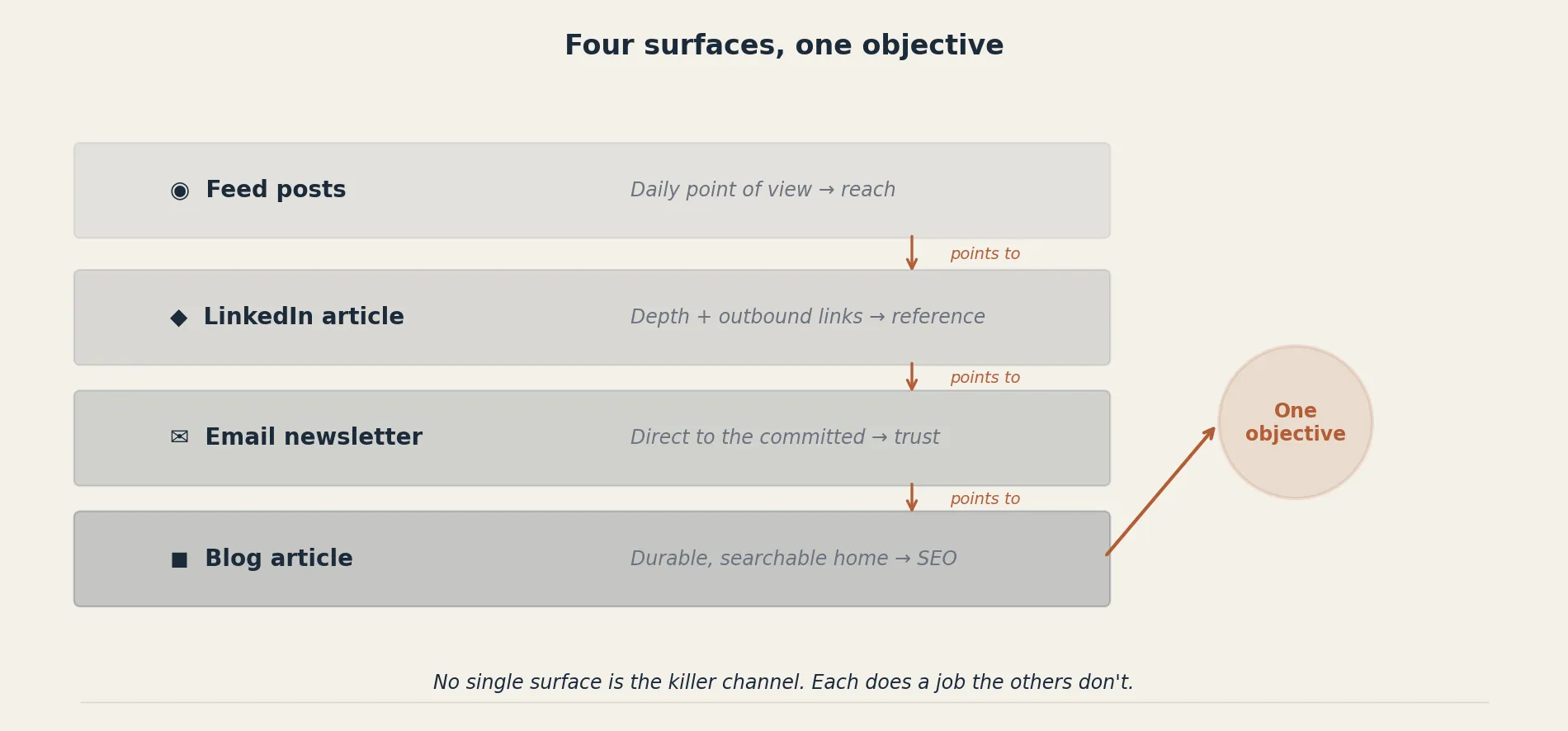
Four layers, each complete on its own, each pointing at the next. A short post on Tuesday morning shares a single observation from a client meeting. The LinkedIn article takes that observation into an argument that earns the click to your website. The email newsletter goes to the people who have already chosen to hear from me. The blog article keeps the thinking findable for years. One theme, four surfaces, one objective.
No single one of these four carries the load on its own. The feed alone is a blur. The newsletter alone is preaching to the converted. The blog alone is hard to find without the others pointing at it. Together they cover each other's weaknesses, which is the whole point. Feed posts would not matter without a place to point. The blog would not be found without the feed and the newsletter. Each channel exists because the others don't do its job.
Awareness and preference, in one breath
The second half of the principle is the one that makes the difference to revenue: awareness plus preference beats both apart.
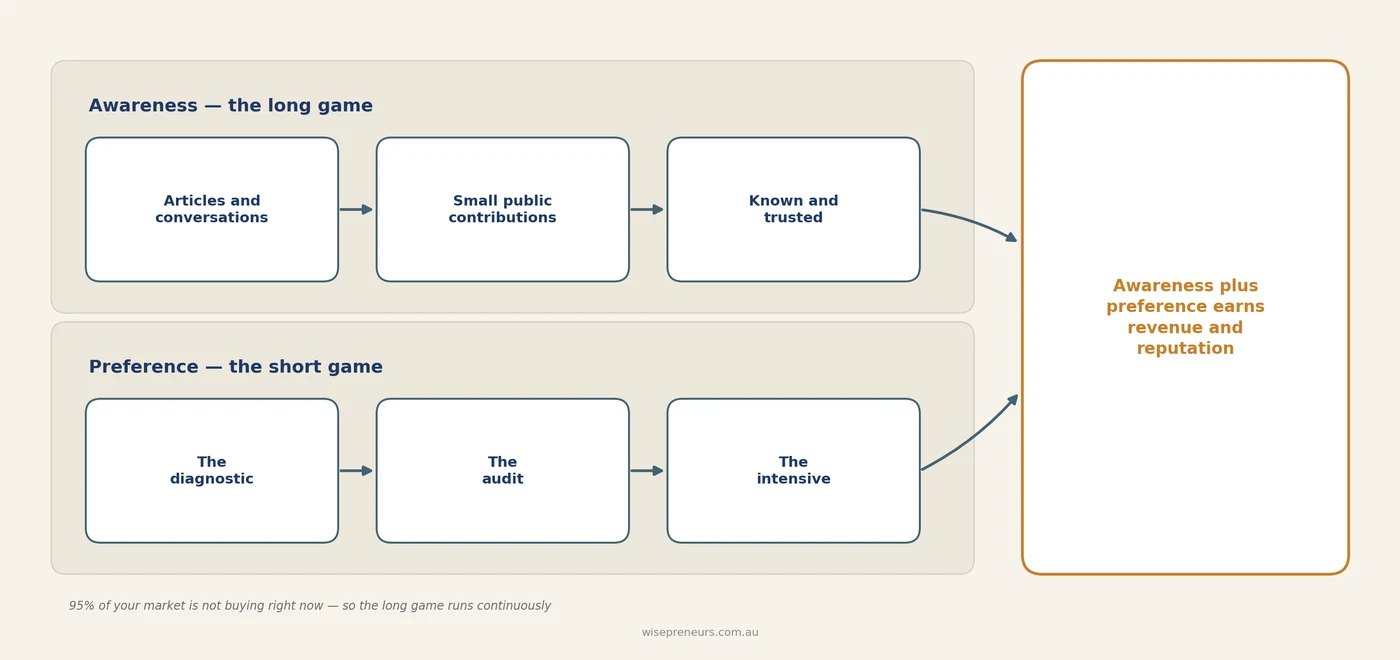
For a one-person practice, awareness is the long game of being known and trusted, the work that builds reputation over a rolling year. It looks like the steady run of articles, conversations and small public contributions that keep making the same point about what you can do, so that when someone needs that capability, your name is the one that comes up. Preference is the specific, current offer: the diagnostic, the audit, the intensive, the thing a ready person can take up this week.
The mistake is running only one. Chase only the short game and you exhaust a shrinking pool of ready buyers. Build only the long game and you become a well-known name that never asks for the work.
The 95:5 rule, from Byron Sharp and Mark Ritson, says most of your market isn't buying right now, which is exactly why the long game has to run continuously rather than only when a strong idea appears. Run both in the same breath, and the long game feeds the short one.
The campaign, not the weapon
Ritson closes with the word that names the whole thing. Campaigns are called campaigns for a reason. They are military operations, fought with lots of weapons at once, coordinated toward a single objective. They were never meant to be won with a single new rifle.
You are not choosing a platform. You are running a campaign, and a campaign is several weapons aimed at one objective. When a colleague tells you about the latest must-have platform, you can ignore the noise. Your practice already relies on a combination, not a single miracle tool.
Frequently asked questions
Does not being everywhere just dilute me?
Being everywhere thinly dilutes you. Running a small number of channels deliberately, each doing a job, concentrates you. The difference is whether each surface has a reason to exist that the others do not cover.
What is awareness versus preference for a one-person practice?
Awareness is the long game of being known and trusted through the steady run of work that makes the same point about what you do.
Preference is the current, specific offer a ready person can take up now.
Most of your market isn't ready this month, so you run the long game continuously and make the offer in the same breath.
How will I know it is working?
Judge visibility over a rolling twelve months, not week to week. The people who become ready at different times are why a single month's numbers always understate your reach. Watch for the specific tells: a name you have not heard from in months getting back in touch, a call booked by someone who opens by citing something you wrote or recorded, an inbound enquiry that arrives weeks after the piece that prompted it.
References
Ben Legg Portfolio Careers and Expertise Monetisation: From Google COO to Solopreneur.
Wisepreneurs Podcast, Episode 87, on where fractional work comes from: 20 per cent listed, 30 per cent found online, 50 per cent from networking and word of mouth.
Mark Ritson, "Brands are all in on creators. Meanwhile in reality, the economics crash", The Drum, 10 August 2026. The no-killer-tool argument and the campaign-as-military-operation line.
Les Binet and Peter Field, The Long and the Short of It. The source of the "and" in Ritson's line, and the brand-plus-activation distinction.
Byron Sharp and Mark Ritson, on the 95:5 rule, Uncensored CMO conversation, 9 July 2026. Most of a market is not buying at any one time, so the long game runs continuously.
Related reading inside Wisepreneurs
Next steps
Write down the combination you can sustain this year, not the platform you hope will carry everything. Name the one surface where your people already are, the durable home for your thinking, and the way people who have chosen to hear from you can be reached. Give each channel one job the others do not do, point them all at a single objective, and let the next shiny object be someone else's problem.
Every Tuesday I send The Wisepreneur, a short letter for experienced professionals building independent practice: one usable idea a week. Sign up at wisepreneurs.com.au/newsletter
When you want a second pair of eyes on your own practice, the Positioning and Practice Audit is how I work with people: wisepreneurs.com.au/marketing-partnership