
At a glance: The bottleneck has shifted from generating ideas to judging which ones matter
AI can generate ideas, drafts, and analyses at a speed and cost that would have been unimaginable five years ago.
What it cannot do is evaluate its own output.
Deciding which of those ideas deserve attention, which assumptions need challenging, and what to actually do next requires the kind of contextual judgment that only builds through decades of professional practice.
The mathematician Terence Tao observed that AI has driven the cost of idea generation to almost zero, shifting the bottleneck entirely to verification and judgment.
Two forces are now compounding in favour of experienced professionals:
- the volume of material that needs evaluating is growing, and
- the pipeline that develops people capable of evaluating it is narrowing.
Your accumulated expertise is becoming structurally scarcer at the same time demand for it is rising.
Information is cheap. Understanding remains expensive. And the gap between the two is widening.
Something has shifted in professional work over the past two years, and most commentary about AI gets it backwards. The conversation is dominated by what AI can produce: the drafts, the analyses, the option sets, the summaries.
What rarely gets discussed is what happens after the output arrives. Someone still has to decide what to do with it. And that decision, it turns out, is where the real cost sits.
The bottleneck in professional work has shifted from generating ideas to verifying which ones matter. That is where your decades of accumulated judgment create their maximum value.
What changed and why it matters
For most of the last thirty years, production was the bottleneck. Researching a market took weeks. A competitive analysis meant gathering data from multiple sources, sorting it, and assembling something coherent. If you could do that work faster or more thoroughly than your competitors, you had a genuine edge.
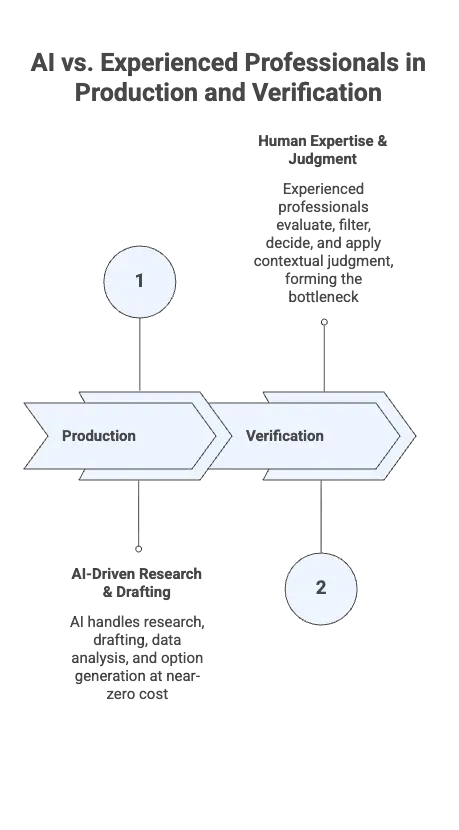
AI has compressed that production cost to almost nothing. A language model can produce a competitive analysis in twenty minutes. It can draft, summarise, and reorganise at a speed no human matches. The work that used to justify three days of consulting time now takes an afternoon.
The instinct is to feel threatened by that. But the threat only exists if production was where your real value sat. For most experienced professionals, it was not. Your real value was always in what happened after the production work was done: the moment you looked at the output and knew what it actually meant for this particular client, in this particular situation.
Terence Tao, the Fields Medal-winning mathematician, put this clearly. He observed that AI has driven the cost of idea generation down to almost zero, much as the internet drove the cost of communication down to almost zero.
"It’s an amazing thing,” he said, “but it doesn’t create abundance by itself. Now the bottleneck is different. We’re now in a situation where suddenly people can generate thousands of theories for a given scientific problem. Now we have to verify them, evaluate them.”
Tao is talking about mathematics, but the principle applies directly to professional practice. The bottleneck has shifted from generating ideas to judging which ones matter.
Information is cheap. Understanding is expensive.
The cost of understanding depends on the complexity of the situation, the prior knowledge of the person, and the quality of the judgment being applied.
AI has made information almost free. It has not reduced the cost of understanding.
If anything, by increasing the volume of plausible-sounding information, it has made understanding harder to reach without experienced guidance.
Why generating ideas was never the hard part
I have seen this pattern repeatedly in the podcast conversations I have recorded over the past six years. An experienced professional walks into a client meeting, and the client already has more ideas than they know what to do with.
Their AI tools have generated plans. Their team has been brainstorming. Consultants have submitted proposals.
The room is full of options.
What the client actually needs is not another option. They need someone who can sort through everything on the table and make a call. This is worth pursuing. That will fail. Here is why. And here is what we do next.
But here is where we need to be honest about how that judgment actually works, because it is not as simple as walking in and knowing the answer.
Ella Zhang, an organisational development consultant I interviewed for the Wisepreneurs Podcast, described her process in a way I found instructive. Her clients call her in, and they almost always frame the problem as a person: “I need you to fix this team member.” Rather than accepting that framing, she asks, “Tell me more. What does the situation look like? What is the context? How did you interact?” She requests conversations with other people in the organisation.
She shadows. She collects her own data.
She described her approach as similar to a Chinese doctor: treating the condition rather than the symptom.
And the critical point is this: even with decades of experience, she does not assume her first impression is correct.
She has the judgment to sense what might be wrong, but she has the discipline to verify it before acting.
That combination, the instinct to sense and the discipline to explore, is what separates experienced practitioners from everyone else.
Tao observed something similar in mathematics. He noted that progress often comes not from adding new theories but from identifying and removing faulty assumptions. Recognising that the question itself is wrong, that the framing contains an embedded assumption that does not hold, requires deep domain knowledge.
For experienced professionals, this translates to a core capability: auditing the assumptions embedded in a client’s problem definition, and often discovering that the real problem is not what the client initially described.
How this plays out in practice
A financial adviser can now generate a dozen portfolio models in an hour using AI. The models are competent. But deciding which one actually suits a particular client, given their risk tolerance, their family situation, their tax position, and the things they have not yet said out loud, that requires a different kind of capability entirely.
The AI generates the options. The adviser’s accumulated judgment determines which one fits. And sometimes the real skill is recognising that none of the models address what the client actually needs, which might be a conversation about their assumptions rather than another set of numbers.
I see the same dynamic in my own work. AI can produce website copy, analyse a competitor’s positioning, and map a customer journey. It does all of this reasonably well. But knowing that a client’s real problem is not their marketing but their positioning, and having the confidence to say so in a meeting, that comes from twenty-five years of watching what actually drives enquiries and what does not. The AI gives me breadth. My experience gives me depth. The two work together, but they are not interchangeable.
This is what Tao describes as breadth-depth complementarity: AI handles the breadth, surveying vast possibility spaces, generating candidates, processing large datasets.
The experienced professional provides the depth: verification, judgment, the ability to recognise when something that looks correct is actually wrong for reasons that require understanding the situation’s deeper structure.
Your clients do not need more options.
They need someone who can look at everything on the table, ask the questions that have not been asked, and make the call that AI cannot make for itself.
The difference between sensing and assuming
There is a temptation, when discussing the value of professional experience, to overstate the case. To suggest that the experienced professional simply walks in, senses the problem, and delivers the verdict. That is how it sometimes looks from the outside, and in rare cases it is close to what happens. But experienced practitioners know the reality is more nuanced.
What experience actually gives you is not certainty. It gives you better starting questions. You walk into a room and something registers, a dynamic you recognise, a pattern you have seen before. Your body may sense the issue before your conscious mind catches up. But the professionals who are genuinely effective do not stop at that first impression. Like Ella Zhang, they use that initial read as a starting point for exploration, not a conclusion.
This matters for how we understand the value of judgment. AI can generate a plan that reads well on paper. A less experienced person might accept that plan at face value.
An experienced professional reads the same plan and notices what is missing: the political dynamic that will block implementation, the assumption about resources that does not hold, the stakeholder whose concerns have not been addressed.
But they still need to verify those concerns. They ask questions. They gather perspectives. They test their initial read against what they discover.
The real expertise is in knowing how to explore efficiently. Where to look. What questions to ask. When the stated problem is masking the actual problem.
That diagnostic capability, the ability to reduce the cost of understanding for your client, is what decades of practice build. And it is precisely what AI cannot replicate, because it requires being in the room, reading the people, and drawing on a lifetime of accumulated context.
Why this advantage is growing, not shrinking
Two forces are compounding here, and both work in favour of experienced professionals.
The first is volume. The more material AI generates, the more judgment is required to evaluate it. When options were scarce and expensive to produce, production was the constraint. Now that options are abundant and cheap, the constraint has shifted to sorting, evaluating, and choosing.
Think of it in economic terms: the cost of information has collapsed, but the cost of understanding what to do with that information has arguably increased, because the volume of plausible-sounding material requiring evaluation has grown enormously.
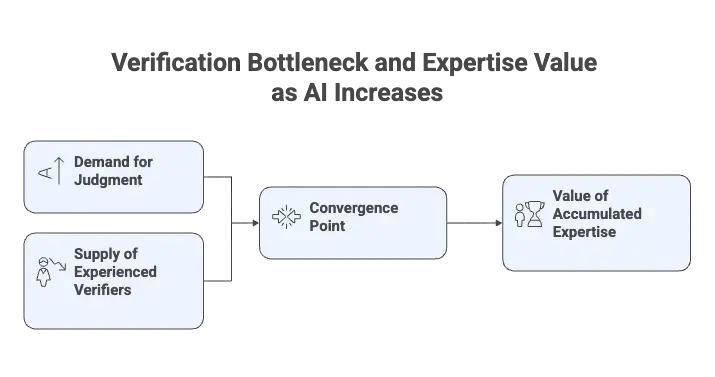
The second force is less obvious and more consequential. The pipeline that produces people capable of this judgment work is narrowing. When organisations automate entry-level tasks, they remove the apprenticeship mechanisms through which the next generation develops judgment. The junior consultant who used to learn by doing the research, making mistakes, and watching how a senior practitioner evaluated the results: that role is being replaced by AI doing the research directly. The hands-on learning pathway that builds judgment over decades is being quietly disrupted.
If you delegate the tasks that build judgment to AI, you remove the learning pathway that produces the next generation of people capable of exercising judgment. This is not just an efficiency question. It is a question about whether the profession reproduces the capability it depends on. Philip Trammell’s research on learning spillovers within workflows demonstrates this clearly: tasks generate learning that improves productivity at other tasks, and automating those tasks removes the spillover learning.
The practical effect: your accumulated judgment is becoming structurally scarcer. Not because experienced professionals are retiring, though many are, but because the pipeline producing replacements is being constricted at the entry point.
Demand for judgment is rising as AI output increases.
Supply of experienced professionals capable of providing it is narrowing as apprenticeship pathways are disrupted.
Your accumulated expertise sits at the intersection of both forces.
What this means for how you position your practice
If the bottleneck has shifted from production to judgment, your positioning can reflect that.
A few things are worth considering.
Your website, your client conversations, and your published content can all demonstrate how you think rather than what steps you follow. The steps are commoditised. The thinking is not.
When you describe your work, the most compelling thing you can share is the moment of diagnosis: the pattern you noticed, the assumption you challenged, the direction you steered a client away from.
Ella Zhang’s “Chinese doctor” framing is effective because it communicates a diagnostic approach without jargon:
she treats the condition, not just the symptom.
AI is genuinely useful for research, drafting, data organisation, and generating options. These are tasks where speed matters and judgment matters less. Where it gets risky is when AI outputs start substituting for your own engagement with the substance of a client’s problem. The professionals who maintain their edge tend to be the ones who use AI to raise their game rather than hand tasks over entirely. They use AI for breadth while keeping their own depth fully engaged.
Publishing your thinking proves useful here too. Every article, guide, or diagnostic tool you produce makes the value of judgment visible to your market. It gives prospective clients evidence that you operate at the understanding layer, not the information layer. They can see how you approach problems before they ever speak with you.
The real question your clients are asking
When a prospective client weighs whether to engage you, the question has changed.
They are no longer asking “can this person produce the work?” Production is cheap now.
The question, whether they phrase it this way or not, is “can this person tell me what is actually worth doing?”
That question gets answered by accumulated practice. By the contextual sensitivity you have built across hundreds of engagements. By the diagnostic capability that knows which questions to ask before you have consciously analysed the situation. By the discipline to explore rather than assume, even when your first instinct turns out to be right.
Your clients are not paying for information. They are paying you to reduce the cost of understanding. To take a situation full of noise and competing options and turn it into clarity they can act on. That is what decades of practice builds. And it is exactly what the market needs more of, not less.
Frequently Asked Questions
What did Terence Tao say about AI and the cost of ideas?
Terence Tao, the Fields Medal-winning mathematician, observed that AI has driven the cost of idea generation down to almost zero, much as the internet drove the cost of communication to almost zero. He noted that the bottleneck has shifted entirely to verification and evaluation: we can now generate thousands of possibilities, but we still need experienced judgment to determine which ones are worth pursuing.
How can experienced professionals position accumulated expertise in the AI era?
Lead with how you think, not what steps you follow. Demonstrate your diagnostic capability through published content, case examples, and frameworks that show prospective clients you operate at the judgment layer. Use AI for production and breadth tasks while maintaining your own deep engagement with the substance of client problems.
What is the difference between appreciating and depreciating professional capabilities?
Depreciating capabilities are production-level skills whose value falls as AI makes them cheap: research, drafting, data analysis, option generation. Appreciating capabilities are judgment-level skills whose value rises because they cannot be automated: contextual diagnosis, assumption-auditing, reading the room, knowing which questions to ask.
Experienced professionals hold concentrations of appreciating capabilities built through decades of practice.
What does the shift from ideas to judgment mean for pricing consulting services?
When your value sits at the judgment layer, pricing reflects the quality of understanding you create rather than the hours you work. A consultant who identifies the core issue in a first meeting and prevents six months of misdirection has reduced the client’s cost of understanding from six months to one conversation. That judgment commands premium positioning because no amount of AI-generated output can substitute for it.
References
Terence Tao – Dwarkesh Podcast interview on AI and mathematical discovery (March 2026). Tao is a Fields Medal-winning mathematician whose analysis of AI’s role in mathematical research provides an operational model for how experienced professionals and AI work together. His key observations referenced in this article: AI has driven the cost of idea generation to almost zero, shifting the bottleneck to verification and judgment; AI handles breadth while humans provide depth; and progress often comes from identifying faulty assumptions rather than generating new theories.
Ella Zhang – Wisepreneurs Podcast interview (forthcoming). Zhang is an organisational development consultant based in Sydney with a background in law and behavioural science. Her “Chinese doctor” approach to client diagnosis, treating conditions rather than symptoms through systematic exploration, illustrates how experienced professionals combine intuitive pattern recognition with disciplined investigation.
You can listen to Ella Zhang Inner Operating Systems: Building Leadership Capability Through Micro Habits on the Wisepreneurs Podcast
Philip Trammell – “Workflows and Automation” (February 2026). Economic research demonstrating that tasks generate learning spillovers that improve productivity at other tasks. Automating those tasks removes the spillover learning, which has implications for how professionals decide which work to delegate to AI and which to retain for their own cognitive development.
The cost of understanding framework draws on work by Daniel Andersen and Nathaniel Fast, whose research on epistemic interactions and the economics of understanding informs the Wisepreneurs approach to professional value: information is cheap, understanding is expensive, and experienced professionals reduce the cost of understanding for their clients.
Next step: If you recognise this shift in your own practice but find it difficult to articulate clearly, the Strategy Intensive ($500 AUD) works through exactly this. I map your accumulated expertise, identify which of your capabilities are appreciating in value, and build a positioning brief you can act on immediately. Read more about the strategy intensive on the marketing partnership page.