
At a glance: Positioning is the decision about which of your capabilities your practice stands on
Most positioning advice hands you a description exercise:
- pick a niche
- write a unique selling proposition
- list your services
That's how a vendor thinks about it.
Positioning for an experienced independent professional is a sorting exercise.
One pile is appreciating: the reading of situations, which sharpens with each new one you meet.
The other is depreciating: the codifiable work AI and cheaper competitors are already absorbing.
Then decide which two or three capabilities the practice rests on, and say no to the rest.
The description is the easy part, and it comes last.
Sort your own two piles with the Positioning and Practice Audit – twenty minutes, and it tells you which capabilities your practice can actually stand on.
My value is not in how fast I think... my value is in how I frame the problem and explain it to my client and then how we converge on solutions together.
Johanna Rothman, independent consultant of thirty years
Why freelance positioning advice fails experienced professionals
If you came here looking for freelance positioning strategies, most of what's written under that phrase is for someone starting out, deciding whether to go independent.
An established practice is answering a different question: which of your capabilities it rests on.
From here I'll use independent professional, because that's who I'm writing for.
I run 13th Beach Marketing Services and I host the Wisepreneurs podcast. My guests are highly successful independent professionals who share their expertise, alongside a range of other guests – authors, academics, consultants. That's the position I'm writing from.
A long services list still leaves the buyer guessing
Take a consultant with thirty years behind her and a website that lists six services.
- Strategy
- Facilitation
- Training
- Coaching. Review
- Implementation support
Every line is true. She can do all six. And a buyer reading that page has no idea what she really stand for.
The list is honest and it's also a hiding place. Six services means the buyer has to work out which one they need, whether she's good at that one, and how she differs from the four other people whose sites list the same six. The easier path is to go with whoever was recommended, or whoever looks specific.
Sharing a client's world is not a position. It is a membership. A position is the reading you do once you are in the room – the same kind of situation, seen the same way, every time.
Meredith Fuller OAM, a psychologist with more than forty-five years of practice, put the underlying problem like this when I spoke with her:
If we can't articulate it, we become invisible.
She was talking about introverted professionals inside organisations. The same articulation problem shows up on a services page that lists six things and cannot say what the practice is for.
Positioning as a sort
Positioning is a sorting problem before it's a writing problem.
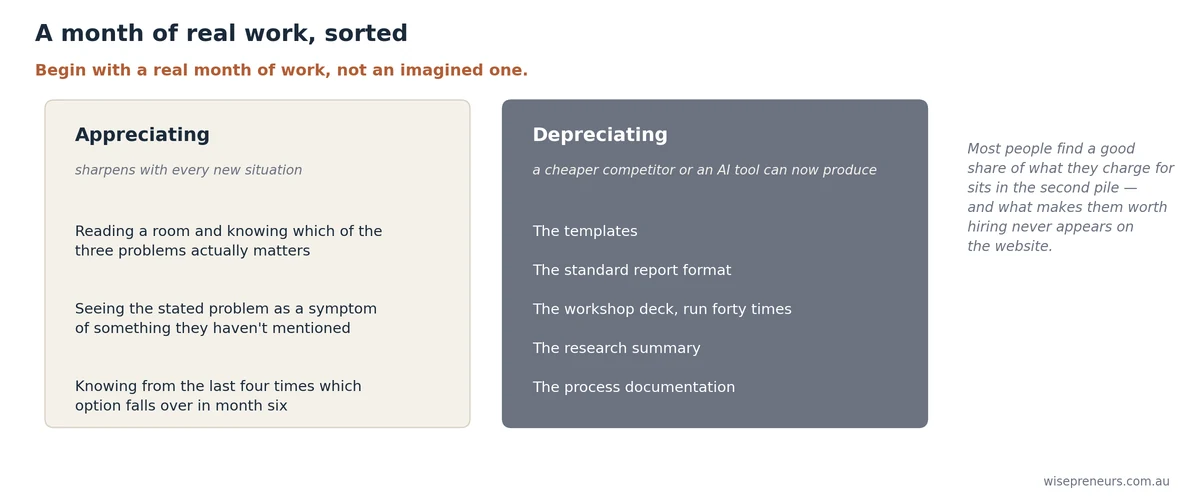
Take everything you do in a working month and put it into two piles.
One pile is appreciating |
This is the work that gets better the longer you do it and can't be handed to anyone else:
- reading a room and knowing which of the three problems on the table is the one that actually matters;
- recognising that the client's stated problem is a symptom of something they haven't mentioned;
- knowing from the last four times you saw this pattern which option will fall over in month six.
It appreciates because every new situation you meet adds to the stock of situations you can compare against.
The other pile is depreciating
- The templates
- The standard report format
- The workshop deck you've run forty times
- The research summary
- The process documentation
This is real work, and often the work you get paid for by the hour. It's also increasingly the work a cheaper competitor or a language model can produce to an acceptable standard.
Do the sort honestly and you may find a good share of what you charge for sits in the depreciating pile, and a good share of what makes you worth hiring never appears on the website.
Johanna Rothman, who has run an independent consulting practice for thirty years and written twenty-one books, is direct about where the line sits. On being told AI can summarise everything she's written:
you can look there and you can get the information. You won't get my value that adds to that information.
Her books are the depreciating pile. They've been scraped, and she's relaxed about it. The appreciating pile is what happens when a stuck middle manager describes their situation and she frames the problem in a way they hadn't considered.
Then comes the decision. Which two or three of the appreciating capabilities does the practice rest on? Sometimes it's one. This is the part people skip, because choosing two means declining the others, and declining feels like leaving money on the table.
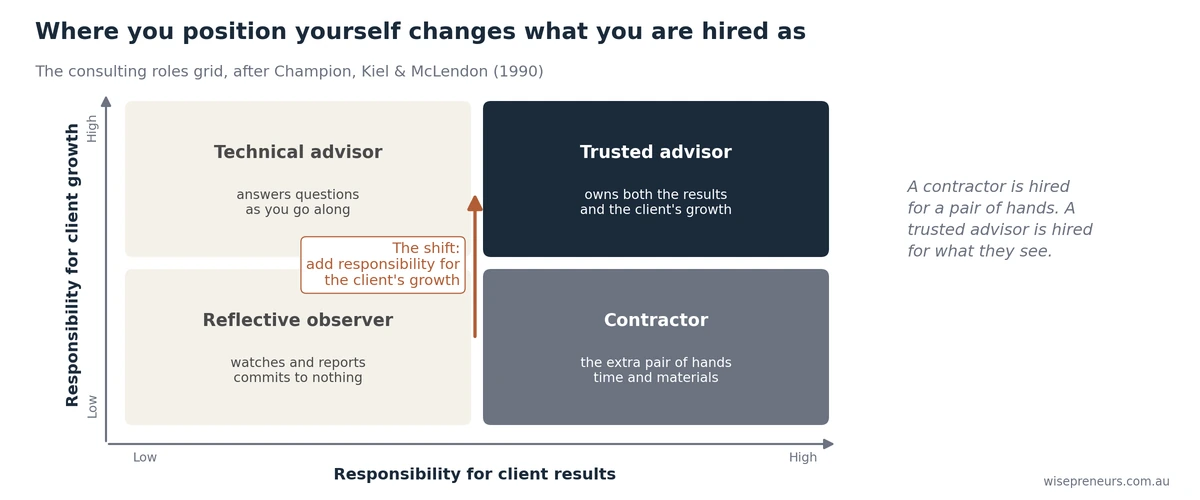
The vendor trap: leading with deliverables instead of diagnosis
There are two ways to open a conversation with a prospective client, and they produce different businesses.
The first leads with deliverables
Here's what I do, here's the package, here's what it costs. The buyer can now compare you against two other quotes on scope and price, because you've given them the terms on which to do it. That's the vendor position, and it's a reasonable place to be if you're competing on efficiency.
The second leads with diagnosis
Before you propose anything, you spend the first conversation working out what's actually going on. The buyer is talking to someone who is diagnosing rather than pitching. Price comparison gets harder, because there's nothing standard to compare.
Rothman's description of her own value is a diagnosis-led practice in one sentence: how she frames the problem, explains it to the client, and converges on a solution with them. The framing is the product. Whatever gets delivered afterwards is downstream of it.
The trap is that deliverables are easier to write about. A diagnosis-led practice is harder to put on a page.
Leads with deliverables | Leads with diagnosis |
|---|---|
named packages and scope | the first conversation is the work |
price is comparable | the situation is named before anything is proposed |
buyer decides what they need | comparison is difficult |
you're one of three quotes | the buyer arrives already persuaded |
the work is specified before it's understood | scope follows the diagnosis |
You are not selling the information, and you are not selling the hours. You are selling how much less time it takes them to see the situation clearly.
Principles outlast practices, and that decides what to build on
There's a version of positioning that chases whatever is current. Two years ago it was one methodology, now it's an AI-adjacent variant of the same thing, and the website gets rewritten each time.
Rothman puts it like this:
that brand new thing is a tactic, not a strategy or a principle. And principles are long-lived.
She described how she built her early workshops:
I offered principles, not practices – giving clients a set of options and the reasoning to choose between them, rather than one prescribed method.
- A practice sells the method, so when the method dates, the practice dates with it.
- A principle holds across situations, which means the same underlying capability keeps earning as the surface changes.
It also means you can be useful to a client whose circumstances don't match your usual case, because you're not carrying a template that has to fit.
Ask yourself: Thinking of the capabilities you've shortlisted, which ones will still be true in ten years?
That's usually where the position belongs and is reflected in what I wrote elsewhere as the paradox of expertise – the better you get, the harder your advantage is to see from outside, and the more it needs deliberately naming.
A good name beats a personal brand
The moment positioning gets discussed, personal branding usually arrives with it, and I'd separate the two.
Robert Vlach, author of The Freelance Way, draws the distinction clearly.
A good name is something ancient and robust. It's mostly created by other people talking about you behind your back.
It takes five, ten years or more, and it comes from having enough clients who can say they worked with you and the work was first rate.
A personal brand is a marketing discipline. It can be built faster, and it can be built on an image that doesn't match the work. Vlach's warning on that gap:
You may be known, but not renowned.
A position other people can repeat about you is worth more than a position you assert about yourself.
So the test on any positioning statement is whether a past client could say it back, in their own words, to someone in a lift. If it's too abstract for them to repeat, it isn't doing the job, no matter how well it reads on your homepage. Some of this is what your website should actually be doing: making the position repeatable, not making you sound impressive.
Write down the last six clients and how each one found you. If most of them arrived through someone else's introduction, the name is already being built – just not by you, and not on purpose.
Why you can't see your own position from the inside
The sorting I've described is hard to do alone.
You keep leading with what only you can report: years, roles, what you know. Clients only ever saw what you did in the room, and what changed after.
The capabilities in the appreciating pile have become automatic, so they fade from view – and the account you give of your own work reads as a job description, because the thing you actually do isn't visible from where you're standing.
What you can report | What a client perceives |
|---|---|
your years in the field | what you did in the room |
your roles and titles | what a client saw you do |
what you know | what changed for them after |
Krystal Hille, who mentors professionals through writing their books, described what she does in a way that fits positioning exactly:
authority isn't created... it is recognized, it is uncovered.
Her work is largely conversational. She identifies patterns and beliefs running through what someone has done, and gives them language for it, because the person can't see the pattern from inside their own career.
That's an argument for doing this with someone else in the room. A colleague who has watched you work, a past client you can ask directly, a facilitated conversation. What you're after is a report from outside: what they came to you for, what they'd have missed without you, how they describe you when you aren't there.
Vlach's good name and Hille's uncovered authority are the same fact seen twice – the useful description of you already exists, in other people's heads.
That's the same ground as relational authority: reputation as something that accumulates in other people's minds, not something you build and display.
What to actually do: the sort, the statement, the refusal
Three steps, in this order. The last one is the one that gets skipped.
Do the sort. Take a real working month, not an imagined one. List everything you did. Put each item in the appreciating pile or the depreciating pile, and be hard about it: if a competent person with a good AI tool could produce something acceptable, it's depreciating. Then note what proportion of your income comes from each pile. That number is usually the finding.
Then run the second test. Write twenty things you know about this work that a competent generalist would not. If you stall at six, that stall is the position – you can do the work and still not have the sentence.
Write the statement from the appreciating pile only. Two or three capabilities, named concretely. Name the actual thing: the kind of situation you're called into, what you see in it that others don't, and what changes as a result. Say it in language a client would use, and test it by asking one whether they'd repeat it. Concrete, then the label. Never the label alone.
Then refuse something. A position that costs nothing is only a description. Refusing means declining the depreciating work that pays, or pricing it so it stops arriving, or handing it to a subcontractor. This is where positioning meets pricing, because how you charge either supports the position or works against it. Hourly billing on diagnostic work says the value is in the time, when the time is the least of it.
Where your consulting fees are set — high enough to keep you scarce, low enough to keep the work arriving — is the same decision as the position itself.
You don't have to do all three at once. The sort without the refusal leaves the practice unchanged: a new description on the same work.
Frequently asked questions
I've been doing this for thirty years – why can't I explain what makes me valuable?
Because the capabilities that make you valuable became automatic long ago, and automatic things stop being visible to the person doing them. This is normal. The reliable fix is an outside read: ask three past clients what they'd have missed without you, and listen for the words they repeat.
Does positioning still work when AI can do so much of the professional work?
It matters more, because AI has made the depreciating pile bigger and cheaper. Positioning on codifiable output puts you in direct comparison with a tool that doesn't sleep. Positioning on the reading of a specific situation, which of the options in front of this client is worth pursuing given how the last four played out, puts you somewhere the comparison doesn't reach.
What should I do if my services page lists eight things I do?
Keep doing all eight if you want the income, and stop leading with all eight. Choose the two or three from the appreciating pile, build the page around them, and let the rest sit further down as supporting work.
Isn't refusing work risky when the pipeline is thin?
It can be, and the sequencing matters. Refuse from the depreciating pile first, and only after the appreciating work has started arriving on the strength of the new statement. Positioning is typically a twelve-month change.
References
Johanna Rothman Independent Consulting: Principles That Outlast Every Trend. Wisepreneurs Project podcast, Episode 92, on principles versus practices, why that brand new thing is a tactic, and the value that remains when AI has absorbed everything you have published.
Robert Vlach Professional Reputation: Why Your Good Name Beats Personal Branding. Wisepreneurs Project podcast, Episode 75, on the difference between a good name built by others over years and a personal brand built by yourself in months.
Meredith Fuller OAM Invisible Expertise: How Introverted Professionals Articulate What They Know. Wisepreneurs Project podcast, Episode 81, on articulation as the condition of being seen at all, and what happens to capable people who cannot describe how they work.
Krystal Hille Expert Positioning: The Book That Makes Your Expertise Visible. Wisepreneurs Project podcast, Episode 98, on authority being uncovered rather than created, and why the pattern in your own work is invisible from the inside.
Books
David C. Baker, The Business of Expertise – the vendor versus expert distinction that sits underneath the diagnosis-led argument here.
April Dunford, Obviously Awesome – positioning as a deliberate choice of competitive context rather than a description exercise.
Blair Enns, The Win Without Pitching Manifesto – the pricing and posture lineage behind leading with diagnosis rather than proposals.
Robert Vlach, The Freelance Way – the good name, and the business side of independent practice that expertise alone does not cover.
Johanna Rothman, Successful Independent Consulting – principles over practices, applied to running the practice itself.
Next steps
If the sort is the part you'd rather not do alone, that's the normal answer, and it's the reason the Positioning and Practice Audit exists. It's a structured outside read of what your practice currently rests on, what's appreciating, what's depreciating, and what a client would actually repeat about you.
If you'd rather start on your own, do the month's sort this week and take the finding to one past client. Ask them what they'd have missed if they hadn't hired you. Their answer is usually closer to your position than anything on your website.